Compare cPanel license prices year over year and see exactly what an increase costs your license mix.
Published cPanel store prices. Switch to partner pricing to enter your own rates.
| License | Qty | 2026 | 2027 |
|---|---|---|---|
| Solo1 account | |||
| Adminup to 5 | |||
| Proup to 30 | |||
| Premierup to 100 | |||
| Overageaccounts over 100 |
Optional. Estimates only.
Published cPanel prices per month. Partner rates aren’t public, so they aren’t charted. Click a license to show or hide its line.
Select a license above to show its line.
Retail prices are cPanel’s published monthly store prices, effective in January of each year. Everything is calculated in your browser. cPanel® is a registered trademark of its owner; this calculator is independent and not affiliated with cPanel.
This cPanel price increase calculator works out what a licence price change actually costs your hosting business, across your whole fleet rather than one licence at a time. Enter your licence mix and it returns the monthly and annual difference, the percentage change, and what you would need to charge to cover it. It handles retail pricing and partner pricing. Nothing you enter is stored or sent anywhere.
Enter how many licences you hold at each tier, plus the number of accounts you are running above the 100 included with Premier. The calculator compares the two years side by side and returns your total monthly cost before and after, the annual difference, and the percentage change.
Retail mode uses cPanel's published store prices. The fields are read-only, so there is nothing to fill in beyond your licence counts.
Partner mode makes every price field editable, for both the old and the new year. There's no single partner rate card we could ship as a default — what a partner pays depends on the agreement they hold, and two hosts of similar size can be on noticeably different terms. The fields come prefilled with retail prices, so you only change the rows where your rate differs. If your agreement gives you nothing on a particular tier, leave that row at retail and the maths still works.
Overage is entered as its own line rather than calculated from your licence count. Accounts are spread across servers in ways no calculator can infer, so the honest approach is to ask you.
ChemiCloud is a cPanel partner and buys licences at partner rates. That's the reason partner billing is modelled here at all, and the reason we know the published prices are only half the picture.
Nothing you type is stored, logged, or transmitted. The calculation runs in your browser.
The 2027 rates take effect on 16 December 2026, for existing and new licences alike. Here is what changes.
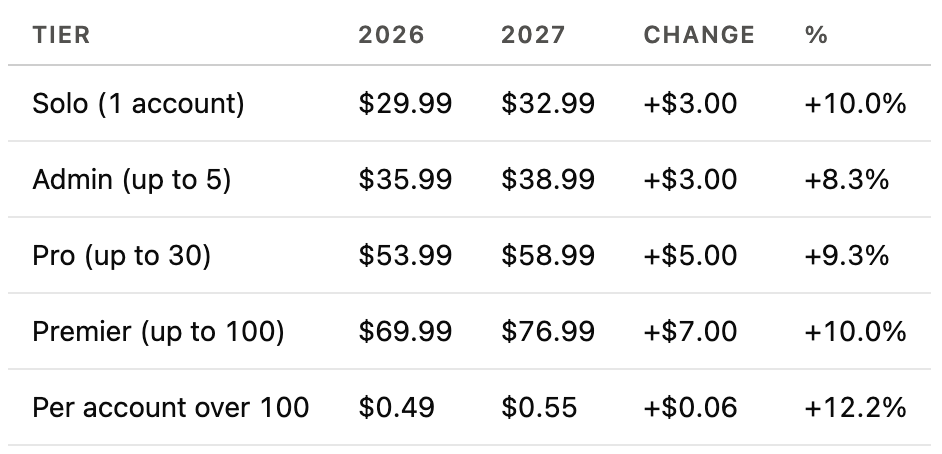
The overage rose fastest. At 12.2% it outpaces every licence tier, and it's the line that scales with how many customers you have rather than how many servers. A Premier server carrying 400 accounts pays the new rate on 300 of them, which is $18 a month more from that line alone. If your servers are dense, this is where your increase actually lives.
Premier took the biggest dollar jump. Seven dollars a month per licence, up from a $4.00 increase the previous year. Anyone who concluded last year that Premier was the gentle tier should look again.
Nothing got cheaper and nothing held flat. Every tier moved, which is now the pattern rather than the exception.
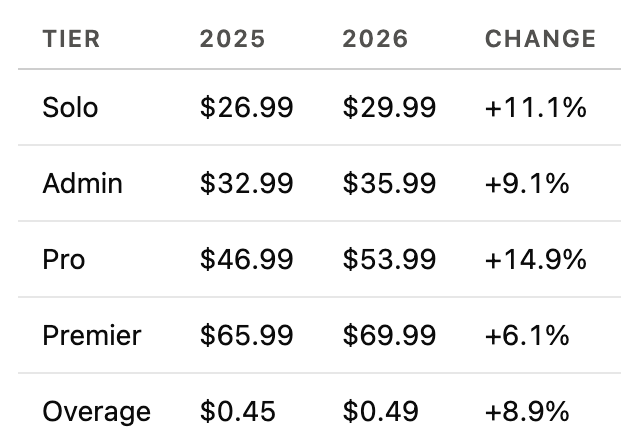
For reference, the previous year's change:
The increases only make sense against what happened in 2019, when cPanel moved from per-server licensing to per-account licensing. Before that change, a dedicated server licence cost somewhere around $45 a month and covered as many accounts as you could fit on the box. Afterwards, the same server running roughly a thousand accounts could cost in the region of $245 a month. That was not an increase in the ordinary sense. It was a different business model, and every adjustment since has compounded on top of it.
The increases only make sense against what happened in 2019, when cPanel moved from per-server licensing to per-account licensing. Before that change, a dedicated server licence cost somewhere around $45 a month and covered as many accounts as you could fit on the box. Afterwards, the same server running roughly a thousand accounts could cost in the region of $245 a month. That was not an increase in the ordinary sense. It was a different business model, and every adjustment since has compounded on top of it.
Solo is the outlier. It sat flat through 2023, moved slightly in 2024, then jumped more than 50% in a single year. An operator running one account on a $10 VPS now pays three times more for the control panel than for the server underneath it.
No single year on this table looks alarming in isolation. That is the point. A host who signed up in 2022 at Pro pricing and never changed anything is paying 50% more for the same software on the same server.
The chart and the table below show retail pricing only. Partner and NOC rates follow a different scale and are not published, which is why the calculator lets you enter your own.
Most of the hosting industry doesn't buy cPanel at the prices on cpanel.net. Partners and NOCs hold agreements with their own rate cards, and those rates sit substantially below retail — Premier at partner rates is roughly a fifth cheaper than the published price, and Solo is about a third cheaper.
Two things about the partner card differ structurally from retail, and both matter if you're modelling costs.
There's a tier retail doesn't have. Partner licensing includes a Plus tier covering up to 50 accounts, sitting between Pro and Premier. If you're between 30 and 50 accounts on a server and buying at retail, you're paying Premier prices for a tier you've barely entered. At partner rates there's a step in between.
Annual billing generally isn't part of it. Partner licensing is normally billed monthly, so the 8.4% annual discount available to retail buyers on Solo, Admin and Pro usually isn't a lever you can pull.
Partner rate history:
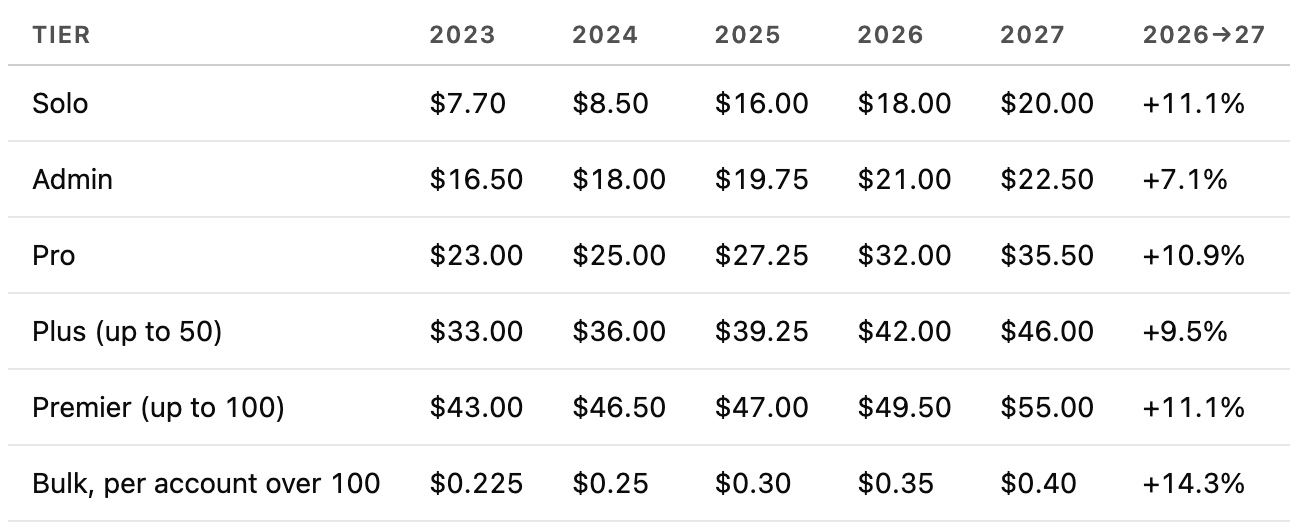
Every tier rises, and the overage rises fastest. Bulk accounts above 100 go up 14.3%, the steepest line on the card. If you run dense Premier servers, that's where your increase lands, not in the licence line everyone looks at.
Premier moves more than it did last year. At retail, Premier rose 6.1% into 2026, the gentlest increase on the table. At partner rates it rises 11.1% into 2027. Anyone who concluded from last year that Premier was the safe tier should recheck.
Solo has more than doubled since 2023, from $7.70 to $20.00. The retail Solo line shows the same pattern. Whatever cPanel is doing to single-account pricing, it's deliberate and it's consistent across both rate cards.
A worked example. A server on Premier carrying 400 accounts, at partner rates:
2026: $49.50 + (300 × $0.35) = $154.50/month 2027: $55.00 + (300 × $0.40) = $175.00/month Increase: $20.50/month, $246/year, +13.3% — on one server.
Multiply by your Premier count. That's why the calculator asks for your overage separately.
Partner rates vary by agreement and the figures above reflect one partner's card. Use partner mode in the calculator with your own numbers rather than assuming these apply to you.
Two things sit outside the tier table, and both are larger than people expect.
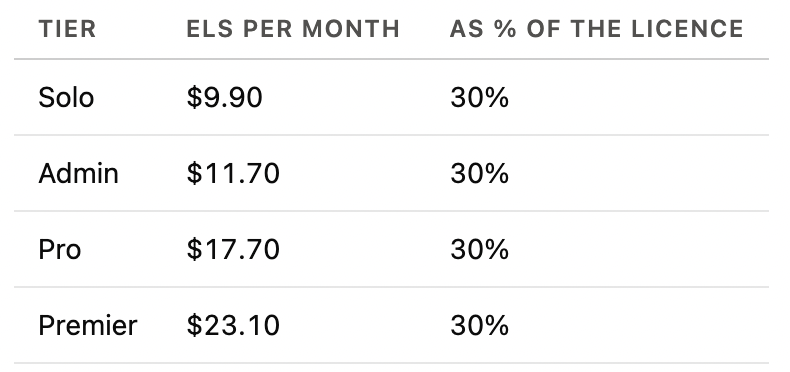
Extended Lifecycle Support. If you're running cPanel v110 on CentOS 7 or CloudLinux 7, there's a monthly ELS surcharge per server on top of the licence:
Most miscalculations come from one of four places.
One account means one main cPanel user, usually a domain owner or a reseller. Addon domains, parked domains and subdomains created inside an existing account do not count toward your total. A reseller holding thirty sites under one cPanel user is one account, not thirty. If you are counting domains, your number is too high.
Solo, Admin and Pro are ceilings. Reach the limit and the next account forces you onto the tier above, whatever the price difference. There is no partial upgrade and no per-account option at those tiers.
Premier is the exception. Above its hundred accounts you pay the per-account rate for each additional one, which is why large servers need the overage line entered accurately.
Each licence is tied to a server and validated against its IP address. Cloud and metal licences differ in how they are provisioned but are priced the same way. Moving a licence between servers means reissuing it against the new IP.
Two things sit outside the tier table. Extended Lifecycle Support surcharges apply to servers on legacy operating systems such as CentOS 7 and CloudLinux 7, and they are billed on top of the licence. And monthly billing costs more than annual, by roughly 8.4%. Neither appears in the headline prices, and both show up on the invoice.
What counts as a cPanel account? One main cPanel user, typically a domain owner or a reseller. Addon domains, parked domains, subdomains and email accounts inside an existing user do not add to the count. Your account total is the number of cPanel users on the server, which you can read directly from WHM.
When does cPanel usually announce price increases? Recent changes have been announced in the autumn and taken effect in December or at the start of the following year. The 2026 rates were announced in late 2025 and applied from mid-December. Treat October through early December as the window worth watching.
Does an increase apply to my existing licences immediately? It applies from the effective date on the announcement, not from the announcement itself. Licences already paid for run to the end of their billing period at the old rate. If you are billed monthly, the first invoice after the effective date carries the new price.
Is annual billing cheaper than monthly? On Solo, Admin and Pro, yes. Annual is priced as eleven months for twelve, so you save 8.3% — about $59 a year on a Pro licence. Premier has no annual option and is billed monthly. Partner licensing is usually monthly as well. So it's a real lever if you run a Pro fleet at retail, and no help at all on Premier or as a partner.
Do I pay for overage accounts I'm not using? No. Overage is charged on accounts that exist, not on capacity. Suspended and terminated accounts should drop off your count, so it's worth auditing before you renew. Stale accounts on a large Premier server are a common source of quiet overspend.
Why is partner pricing different from the prices on cPanel's site? The prices published on cpanel.net are retail. Partners and NOCs hold agreements with their own rate cards, which run well below retail and vary by the size and terms of the arrangement. The partner card also includes a Plus tier for up to 50 accounts that retail doesn't offer. Because the rates differ by agreement, the calculator has a partner mode you fill in yourself rather than a second fixed price table.
When do the 2027 prices take effect? 16 December 2026, for both existing and new licences. If you're billed monthly, the first invoice after that date carries the new rate. If you're on an annual term for Solo, Admin or Pro, you stay at your current rate until that term ends.
What is the ELS fee and do I have to pay it? Extended Lifecycle Support is a monthly surcharge for servers still running cPanel v110 on CentOS 7 or CloudLinux 7 — $9.90 on Solo up to $23.10 on Premier, a 30% uplift on the licence in every case. It stops when the server moves to a supported operating system, so it's avoidable rather than fixed.
Knowing the number is the easy part. Deciding what to do about it is harder, and the answer depends on your margin, your average plan price, and how many of your customers are locked into annual terms you can't reprice yet.
We worked through that in What the cPanel increase costs your hosting business, including how to calculate the per-customer increase you would need and what it costs you to absorb it instead.
ChemiCloud has been on the receiving end of every one of the increases in the table above. If you would rather not run licence maths at all, our reseller hosting plans include the licensing.