Live Chat
 Help Center

For most designers, hosting belongs inside the retainer — as long as the retainer has more in it than hosting.
That’s the short version. The longer version matters because this decision usually gets made on pricing grounds when it should be made on exit grounds. What happens to a client’s website on the day they cancel is decided almost entirely by which invoice their hosting sits on, and hardly anyone decides that deliberately. They find out.
This page assumes you’ve already decided to resell. If you’re still weighing that up, should web designers resell hosting to their clients is the argument, and the guide to starting a reseller hosting business is the whole picture. What follows is about how you bill for it — retainer, care plan, maintenance plan, the same arrangement under three names — and what you owe a client when the arrangement ends.
Table of Contents
- The short answer: bundle it, if the retainer has more in it than hosting
- Four ways designers bill for hosting
- What bundling actually buys you
- When separate billing is the right answer
- Making hosting the smallest line in the retainer
- What you’re committed to vs what you’re collecting
- What happens when a client leaves
- What has to be in writing
- Changing model with clients already on the old one
- Retainer billing mistakes worth avoiding
- Frequently asked questions
The short answer: bundle it, if the retainer has more in it than hosting
Bundle hosting into a retainer when the retainer contains work you actually do. Bill it separately when the relationship is dormant between projects, or when the client won’t take a retainer at all.
The reason to bundle isn’t convenience. It’s that a separately invoiced hosting line is the only item on your invoice with a public market rate attached to it, and that rate is advertised at $2.95 a month on the side of every tech website your client visits. They will see it. Eventually they will ask.
Inside a retainer, hosting isn’t a product any more. It’s an input to a service, and services don’t have comparison prices. That is the entire commercial argument for a designer reselling hosting rather than referring it, and it’s why the separate-line model quietly caps what you can charge no matter how good you are.
But the argument only holds while the bundle is defensible. A retainer that is 90% hosting is a marked-up hosting plan with an extra step, and it cannot survive the question what am I paying you for every month? — because the honest answer is “hosting,” and now you’re having the conversation you bundled to avoid. The bundle protects you exactly as much as it contains real work.
Four ways designers bill for hosting
There are four, and it’s worth naming them because most people arrive having only considered two.
Bundled retainer. One monthly fee. Hosting is invisible inside it.
Separate line, you resell. Your invoice, with hosting itemised — or a second invoice entirely.
Hybrid. Hosting billed annually as its own thing, support and maintenance billed monthly.
Pass-through. The client buys hosting directly in their own name, and you manage it. This is the honest option for one-off builds and price-sensitive clients, and it has a real advantage: none of the liability is yours. It also has a failure mode worth being clear-eyed about, which is that you will still get the call when the site goes down at 2am, and you won’t be being paid for it. If that’s already happening to you, that’s the argument for one of the other three.
| Model | Suits | Revenue per client | At cancellation | Admin | What breaks it |
|---|---|---|---|---|---|
| Bundled retainer | Ongoing relationships, 10+ clients | Highest | Hosting ends with the relationship — unless you’ve said otherwise | Lowest | A retainer with nothing in it but hosting |
| Separate line | Project work, dormant clients | Moderate, capped by the market rate | Clean; hosting survives the relationship | Highest — two products to bill | The client comparing your line to a public price |
| Hybrid | Clients who want annual hosting, monthly support | Moderate | Two separate exits to manage | Medium | The two cycles drifting out of sync |
| Pass-through | One-off builds, price-sensitive clients | None | Nothing — it was never yours | Low, until something breaks | Unpaid support you can’t refuse |
What bundling actually buys you
Hosting stops being a price your client can check
A client who receives a $35 hosting line has been handed a number to investigate. A client who receives a $165 retainer covering hosting, updates, backups, monitoring and an hour of changes a month has been handed a service, and there’s nothing on the market that matches it closely enough to compare.
This is not sleight of hand, and it’s worth being direct about rather than coy. What you’re selling genuinely isn’t the same thing as unmanaged shared hosting. The $2.95 plan doesn’t include someone who notices the site is down, knows what a failed plugin update looks like, and has a backup from Tuesday. Your client isn’t paying a 1,000% markup on disk space. They’re paying for the part where they never think about it.
One invoice, one renewal, one conversation
The operational case is smaller but real. One payment method to expire instead of two. One renewal date. One price conversation a year rather than two staggered ones.
The flip side belongs in the same paragraph: one invoice is also one point of failure. When a bundled payment fails, the site is now downstream of it, which makes a routine billing problem into an availability problem. Decide your suspension timeline before you need it — non-payment, suspensions and getting paid covers how that plays out.
The cost: you’ve coupled the site to the relationship
Here’s the part the pricing articles skip. When hosting lives inside the retainer, cancelling the retainer cancels the hosting. Which means every disagreement about your service is now also, implicitly, a conversation about whether their website stays online.
That’s leverage. Pretending otherwise doesn’t make it go away — it just means you’ll discover it during an argument. The fix isn’t to avoid bundling. It’s to take the leverage off the table in advance by deciding, in writing, what happens to their site when they leave. That’s the last section of this article and it’s the one that matters most.
When separate billing is the right answer
Bundling is the default, not the answer. Bill hosting separately when:
- The relationship is dormant between projects. No ongoing work means no defensible retainer. Charging a monthly fee for a site you touch twice a year is the thin-bundle problem in its purest form.
- The client requires itemisation. Some procurement processes, many non-profits and most public-sector clients simply won’t accept a line that says “monthly services.”
- The client is technical, or is an agency themselves. They’ll read a bundle as opacity, because that’s how they’d read their own.
- You’re building toward selling the book of business. Separable, clearly identified hosting revenue is easier to value and transfer than revenue tangled into personal service relationships. If that’s a real plan rather than a someday, selling a hosting book of business is worth reading before you structure anything.
- You can’t yet deliver what a retainer implies. If you couldn’t answer a support email within a day this month, don’t sell a promise that you will.
Most designers end up running both. Bundled retainers for active clients, a plain hosting-only product for legacy ones who’ll never take a retainer. That isn’t indecision — it’s two products for two genuinely different segments, which is also the only good reason to have two of anything. How many hosting plans you should publish takes that question further.
Making hosting the smallest line in the retainer
If the bundle is what protects your pricing, then the bundle has to be worth something. In practice that means hosting should be a minority of what the retainer costs you to deliver — call it a third at the very most.
What else goes in
| Inclusion | Costs you | Client feels it |
|---|---|---|
| Hosting, SSL, domain management | Your plan cost per account | Rarely — until it’s down |
| Backups, and restores on request | A little time, occasionally | At the worst possible moment |
| Core, plugin and theme updates | Real recurring time | Indirectly, by nothing breaking |
| Uptime monitoring and response | Setup, then almost nothing | Yes — when you get there first |
| A monthly allowance of content edits | Real time, capped | Every single month |
| Security scanning and malware response | Little, until it happens | Enormously, once |
| An annual review call | An hour | Yes — and it’s renewal insurance |
The monthly edit allowance is the item that does the most work for the least money. It’s the only line the client interacts with directly, it caps your exposure by definition, and it converts a passive fee into a service they use. Backups are the other one worth attention, because who restores a deleted site and from how far back is the entitlement clients feel most sharply when they need it.
A composite example, using round numbers. Fourteen clients on a reseller plan costing $46 a month at its regular rate — that’s about $3.30 per client per month for the hosting itself. The retainer is $165. Delivering it takes you, honestly measured, somewhere around ninety minutes a month per client across updates, edits and the occasional question.
Hosting is 2% of the price and a rounding error against the time. That’s what a healthy bundle looks like: the thing the client can price-check is the smallest thing in the box. Run the same arithmetic on a $40 “retainer” that consists of hosting plus a quarterly glance, and hosting is most of the cost, most of the value and all of the argument you’re about to have.
Setting the actual number is a separate exercise — how to price reseller hosting plans builds the unit cost properly, and the reseller profit calculator will run it against a specific plan. What this section is about is composition, not price.
What to say when a client asks what the hosting costs
They will ask, usually at renewal, usually because someone else mentioned a number to them.
The answer that works is the true one: hosting is part of what the plan costs to run, it isn’t sold separately, and here’s what the plan covers. Then offer the alternative out loud — you can move them to hosting-only at a stated price, without the maintenance, and they can look after updates themselves.
The offer is what makes the refusal credible. It also almost never gets taken, and when it does you’ve learned something useful: that client belongs in the separate-billing segment, and you’ve found that out in a conversation rather than in a cancellation email.
What you’re committed to vs what you’re collecting
Retainer revenue arrives monthly. Reseller plans are bought in terms. You’re collecting in twelfths against a cost you may have committed to for a year.
Mostly this doesn’t matter — the numbers are small next to a retainer, and a reseller account is one of the cheapest things in your business. Two consequences do matter.
A client who cancels in month two doesn’t cancel your cost. The account slot is bought. That’s an argument for a notice period in your retainer, not an argument against bundling.
The renewal cliff
This is the one that quietly eats retainer margins.
Reseller plans across the industry advertise a promotional rate for the first term and renew at a regular rate that is substantially higher. Ours are published, so they make a usable example (verified 12 September 2026):
| Plan | Promotional | Regular |
|---|---|---|
| Kickstart | $17.95/mo | $34.95/mo |
| Grow | $19.95/mo | $45.95/mo |
| Expand | $34.95/mo | $61.95/mo |
| Established | $49.95/mo | $77.95/mo |
Roughly a doubling, and it is not unusual — check any provider’s renewal rate against its headline and you’ll find something similar.
Now put that next to a retainer. Hosting plans get renewed and reconsidered annually because an invoice arrives and you look at it. Retainers get set once, in a proposal, and then run untouched for years. So the failure pattern is predictable: you price a retainer in year one against a promotional hosting cost, the cost doubles at renewal, and the retainer doesn’t move.
The rule is simple. Price the retainer against the renewal rate, not the signup rate. Then put a price-review date in the calendar in the same hour you write the proposal, because raising hosting prices on existing clients is much easier when the contract already says you review annually.
What happens when a client leaves
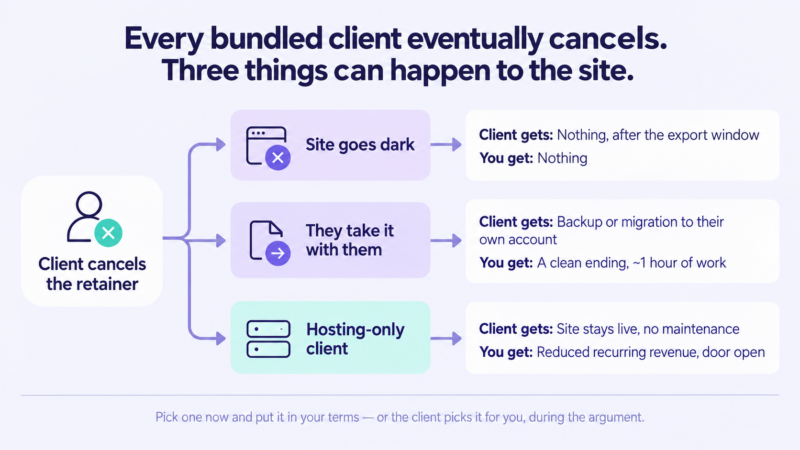
Every bundled client will eventually cancel, and the site doesn’t cancel itself. Three things can happen to it. You are choosing one of them whether or not you realise it.
The three endings
It goes dark. The retainer ends, the account is suspended, the site is gone. This is defensible — but only if the client was told in advance and the export window is real. As a surprise, it’s the thing that generates the review you’ll be reading for five years.
They take it with them. You hand over a full cPanel backup, or migrate the site to an account in their name. It costs you an hour and it ends the relationship cleanly, which is worth more than the hour. Migrating client sites without downtime covers the mechanics in both directions.
They stay as a hosting-only client. The retainer ends, the hosting continues at a stated price on its own invoice. This is the ending most designers never think to offer, and it’s often the one the client actually wants — they’re cancelling the maintenance they weren’t using, not the site they depend on. It keeps some revenue, keeps the door open, and turns a cancellation into a downgrade. Why hosting clients leave is worth reading alongside this.
The transfer-out policy
Write this once and it serves every client you’ll ever have. Six things to decide:
- The export window. A stated number of days after the final paid period during which the account stays live. Thirty is normal and costs you almost nothing.
- What they receive. A full cPanel backup, or a migration to an account in their name. Say which.
- Who holds the domain. The strong recommendation, whichever billing model you use: the client owns their own domain registration. Domains held by a departing designer are the single most common cause of bad endings in this business. If you do hold it, document how it transfers and don’t make that a negotiation.
- Email. The most easily forgotten asset and the one they’ll notice missing within an hour.
- Who does the work. Whether a migration is included or billed, and at what rate.
- What you don’t hand over. Your WHM, your reseller account, anything belonging to another client.
Wording it doesn’t need to be elaborate. Something close to: “If this agreement ends, your website and email remain available for 30 days. During that time we’ll provide a complete backup, or transfer your site to a hosting account in your name at no charge. Your domain is registered in your name and stays with you.”
That’s the shape. Have your own terms checked by someone qualified, and see terms of service and AUP for a small host for the rest of what your service terms should cover.
What has to be in writing
A short checklist. Each of these exists because the version without it ends badly.
- What the retainer includes — itemised, even though the price isn’t
- What it explicitly excludes: new pages, redesigns, third-party licences
- Notice period, both directions
- Minimum term, if you have one
- Which of the three endings applies at cancellation
- The export window, stated in days
- Who owns the domain
- Backup frequency, retention, and who performs a restore
- Support response expectations you can meet in a bad week, not a good one
- An annual price-review clause
- Suspension terms for non-payment
One consistency check before you publish any of it: everything you promise in the retainer has to be something the hosting account underneath it can actually deliver. Promising 90 days of backups on a plan that keeps 30 is a promise you’ll discover you made at the exact moment it matters.
Changing model with clients already on the old one
You aren’t locked in. The direction of travel just has different costs.
Separate to bundled is the easy one. Do it at renewal, one client at a time, framed as adding maintenance rather than raising a price. If the total goes up, be honest that it’s a price increase and handle it as one.
Bundled to separate is harder, because you’re revealing a number that used to be invisible. Do it at renewal, and set the itemised hosting figure at what you’d charge a hosting-only client — not at your cost. The moment you itemise at cost you’ve taught the client what your margin was.
Don’t run both models in the same segment without a reason you can state in one sentence, because two similar clients will eventually compare invoices.
The reassuring arithmetic is the same as it is for plan structure: adding is cheap, unwinding is expensive. That’s the argument for starting with the simpler bundled model rather than a hybrid you’ll spend next year simplifying. And if the change you’re making is taking over hosting a client currently buys elsewhere, telling existing clients you’re taking over their hosting is the conversation to have first.
Retainer billing mistakes worth avoiding
- Hosting bundled in at zero — “hosting’s on me, don’t worry about it” — a gift you renew every month forever
- A retainer that’s 90% hosting
- Pricing the retainer against a promotional hosting rate
- No stated ending: no notice period, no export window, no answer to “can I have my site?”
- Holding the client’s domain registration by default
- A support promise you can only honour in a quiet month
- A four-year-old retainer at a four-year-old price
- Itemising hosting inside a bundled retainer “for transparency” — it recreates the comparable price you bundled to avoid
Frequently asked questions
Should web designers include hosting in their retainer? Usually yes, provided the retainer contains ongoing work — updates, backups, monitoring, an allowance of changes. Bill hosting separately when the relationship is dormant between projects, or when the client requires an itemised invoice.
What do you say when a client asks how much the hosting part costs? That hosting is part of what the plan costs to run and isn’t sold separately, followed by the offer of a hosting-only arrangement at a stated price without maintenance. The offer is what makes the answer credible, and it’s rarely taken.
What happens to a client’s website if they cancel a retainer that includes hosting? Whatever you decided in advance. There are three endings: the site goes dark after an export window, the client takes it with them as a backup or migration, or they continue as a hosting-only client on a separate invoice. Put the one you’ve chosen in your terms before you need it.
Is it acceptable to charge more for hosting than you pay for it? Yes. You’re not selling disk space at a markup, you’re selling managed hosting — someone who notices the outage, applies the updates and holds a backup. That’s a different product from the one with the advertised price, and it’s priced differently for the same reason a restaurant charges more than a supermarket.
Once the structure is settled, the next decision is the number. How to price reseller hosting plans builds the unit cost from your actual plan and shows what margin each client leaves you with, and how much you can actually make reselling web hosting runs it across a whole client base. If you’re going the bundled route, how many hosting plans you should offer makes the case that the answer for retainer-based designers is often none at all.
One thing worth checking before you write a retainer price: the hosting inside it is only as predictable as the account underneath it, and what that account costs at renewal is the floor under every retainer you sign. It’s worth comparing reseller plans on that basis rather than on the headline rate.