Live Chat
 Help Center


If you build websites for clients, someone has to host them, and there are two ways to earn from that: resell the hosting under your own name, or refer clients to a host and take a commission. Most designers end up doing a third thing by accident. They either tell clients “just buy hosting somewhere” and earn nothing, or pay for client hosting on their own card and pass the bill on.
The short version: resell if you want to own the client relationship, the monthly margin and the support. Refer if you want to hand all three to the host for a one-time fee. Neither is the better business in general. One of them is better for you, and it’s usually obvious once you look at who your clients already call when something breaks.
This sits one step before the reseller hosting guide, at the point where you decide whether to get into hosting at all.
A disclosure, because it matters here: ChemiCloud runs a reseller program and an affiliate program, so we’re paid either way. That’s why we can tell you plainly which one doesn’t fit.
Table of Contents
- The short answer
- The difference that decides it: who owns the client
- How the money actually works
- What you’re signing up for besides money
- When referring is the better business
- When reselling is the better business
- The rules that catch people out
- Doing both without getting it wrong
- How our two programs compare
- Decision checklist
- Frequently asked questions
- Resell or refer: where to go next
The short answer
| If you… | Then… |
|---|---|
| Build and maintain sites for clients who expect you to sort out hosting | Resell. You’re already the first call. Get paid for it. |
| Build sites, hand them over, and don’t want evening emails about them | Refer. Take the commission and let the host do support. |
| Pay for clients’ hosting on your own card and re-invoice it | Stop doing that. You carry the responsibility without the margin, and it doesn’t qualify for a commission. |
| Publish to an audience that buys hosting: a blog, a channel, a newsletter | Refer. Reselling is a service business. You’re running a media one. |
| Have no clients and no audience yet | Neither, yet. Get one or the other first. |
| Manage some clients and have an audience as well | Both, with a clear line between them. |
The close calls come down to one question: if this client’s site went down tonight, would they call you or the host? If they’d call you, you already own the relationship, and reselling just puts a price on it.
The difference that decides it: who owns the client
Most comparisons frame this as a skills question: reselling needs technical knowledge, affiliate marketing needs marketing skills. That framing sends designers the wrong way. The question that decides it is ownership.
| Reselling | Referring (affiliate) | |
|---|---|---|
| Who the client pays | You | The host |
| Who sets the price | You | The host |
| Whose brand they see | Yours | The host’s |
| Who they contact for support | You (the host supports you) | The host |
| Whose terms they’re under | Yours | The host’s |
| What you earn | Your margin, every month | A commission, usually once |
| When you’re paid | Monthly, through your own invoicing | After a qualifying period, once you reach a payout minimum |
| Upfront cost | A reseller plan | Usually nothing |
| What happens if you stop | You move the clients or hand the book on | They stay with the host |
| What you can sell later | A book of hosting clients | Nothing tied to those clients |
Two things in that table get missed.
The skills point is mostly wrong. On a managed reseller plan you don’t administer servers; the host does. What you need is enough WHM to create and manage accounts and the willingness to be the first person a client contacts. Affiliate work doesn’t need “marketing skills” in the abstract either. It needs people who trust your recommendation, whether that’s an audience or a network of clients.
The last row matters more than it looks. A reseller book is a business you can sell to someone else when you move on. A history of referrals isn’t worth anything to a buyer.
How the money actually works
Asking which model “makes more” without a time frame gets you nowhere, because one pays once and the other pays monthly. The useful comparison is when each one pays, and for how long.
Referring: paid once, early
Most hosting affiliate programs pay a fixed amount per new customer, sometimes tiered by how many you refer in a month. A few pay a recurring percentage instead. Ours is the fixed kind, so it makes a concrete example:
- $50 per qualifying sale when you refer one to five in a calendar month, rising to $100 for six to ten, $150 for eleven to twenty and $200 for twenty-one or more.
- A sale qualifies once the account has stayed in good standing for 45 days, which lines up with our 45-day money-back window.
- You can request a payout once your balance reaches $250, paid on the first of the following month.
Three practical consequences follow. The money arrives in month two or three, not month one. At the bottom tier, five qualifying referrals have to clear before you can withdraw anything. And after that, the client earns you nothing more, however long they stay.
Reselling: paid monthly, eventually
Reselling runs the other way. You pay for the plan before you’ve earned anything, the margin builds as accounts arrive, and the first months can run below zero. How much you can actually make reselling hosting works through it in detail. The example worth borrowing here is a designer with fifteen existing clients paying $25 a month each, on a plan at its full $45.95 list rate, spending three hours a month on hosting support valued at $75 an hour.
That business makes:
- $313.67 a month gross margin, or about $20.91 per client, before your time.
- $88.67 a month after paying yourself for the support hours, or about $5.91 per client.
Both are real numbers. Which one applies to you depends on whether those three hours would otherwise be spent on paid work.
The crossover point
Put the two side by side and one rule falls out:
Reselling a client out-earns referring them once the monthly margin on that client, multiplied by the months they stay, exceeds the one-time commission.
Crossover month ≈ commission ÷ monthly margin per client
Using the figures above:
| Commission per referral | Crossover on gross margin ($20.91/month) | Crossover after your time ($5.91/month) |
|---|---|---|
| $50 (one to five referrals in a month) | Month 3 | Month 9 |
| $150 (eleven to twenty in a month) | Month 8 | Month 26 |
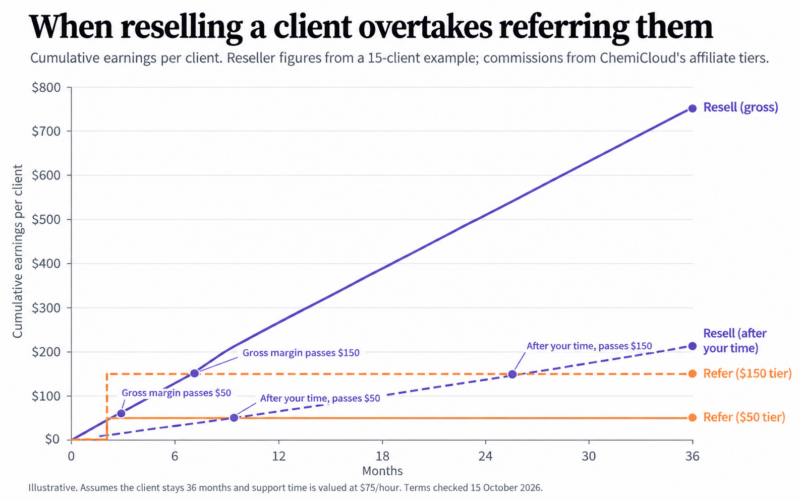
Read it in two halves.
If you have spare hours, reselling wins quickly. On gross margin, a typical managed client has out-earned a bottom-tier commission by month three. Over three years that client is worth about $750 to a reseller against $50 to a referrer.
If your hours are already sold, it’s closer than most articles admit. Price your support time in, and a client takes nine months to beat a $50 commission. If you’d be referring a whole book at once and landing in the $150 tier, it takes more than two years. Over three years, the time-adjusted figure is about $213 per client against $150 up front. Reselling still comes out ahead, but not by much, and its real advantages are elsewhere: the relationship, the retention, and an asset you can sell.
Three caveats keep the rule honest:
- These are per-client figures for a client who stays. A client who leaves in month four makes the commission look better, and why hosting clients leave is worth reading before you assume they won’t.
- They assume fifteen clients sharing the plan cost. With five clients, each one carries a third of the plan, and the reseller margin per client shrinks accordingly.
- Support time isn’t evenly spread. A client who sends a ticket a week may never cross over, and that client is the strongest case for referring.
To run this with your own client count, price and hourly rate, use the reseller profit calculator. The crossover is the commission divided by its monthly figure per client.
What you’re signing up for besides money
Neither model is passive. They load the work differently.
Reselling commits you to:
- Being the first contact for support, including the ones that turn out to be the host’s problem. What hosting support load actually looks like has the realistic picture.
- Communicating during downtime you don’t control.
- Chasing clients who stop paying.
- Knowing who’s responsible when a client deletes their site.
- Having your own terms of service, and holiday cover.
The offset is that the host supports you, so the problems you can’t solve still have somewhere to go.
Referring commits you to:
- Producing the content or the conversations that generate referrals, continuously, because each one pays once.
- Disclosing the commission wherever you recommend the host.
- Following the program’s promotion rules.
- Accepting that your recommendation carries your reputation. If the host lets a client down, the client will remember who sent them.
The real difference is when the work happens. Reselling’s work recurs per client. Referring’s work recurs per new client.
When referring is the better business
- You hand sites over and don’t maintain them. If there’s no ongoing relationship, there’s nothing to earn from monthly.
- The client wants to own their hosting. Larger clients often insist on it, and so does anyone who has been locked out of a site by a previous designer. Respect that and take the commission.
- You have two or three hosting clients and no plans for more. The plan cost eats the margin at that size. Our article’s break-even section shows where the line usually falls.
- Your hours are already fully booked. Hosting support competes with better-paid work, and the time-adjusted crossover above shows how little reselling adds.
- You publish to people who buy hosting. If you write tutorials, run a channel or send a newsletter, you’re running a media business, and an affiliate program fits it. Reselling would add a support desk to it.
- You want to test whether anyone acts on your recommendations. Referring costs nothing to start and answers that question quickly.
When reselling is the better business
- You already maintain the sites. You’re the first call whatever you do, and the margin pays you for it. Should web designers resell hosting? covers what that changes day to day.
- You want hosting inside a care plan or retainer. You can only bundle hosting into a retainer if you sell it.
- You want clients to see your brand, not a host’s. White-label hosting has limits, but referring doesn’t offer it at all.
- You’re building something you might sell. A book of hosting clients has a buyer. A referral history doesn’t.
- Your clients stay for years. Long tenure is the biggest single driver of the crossover.
If that’s you, the reseller hosting guide is the next read, and telling existing clients you’re taking over their hosting covers the conversation that follows.
The rules that catch people out
Affiliate programs all have terms, and a few of them change the comparison. These are the ones that catch designers. Ours are the examples because we can vouch for them, but the categories are near-universal, so read the terms of any program you join.
You can’t refer an account you pay for
Almost every program bans self-referral, and most define it broadly. Ours covers referring any business you control, and any signup paid with a card or account that belongs to you.
That catches the designer who signs a client up and pays for the hosting themselves. It isn’t a qualifying referral, even if the site is the client’s. The client has to sign up and pay with their own details. When they do, it qualifies, including when you build and maintain the site for them.
If you’re paying for client hosting today and re-invoicing it, you’ve already chosen to own the relationship. Either make that official with a reseller plan, or let the client pay the host directly and take the commission.
A referred client is the host’s client
When you refer someone, the host bills them, supports them and owns the account relationship. You can still build and maintain their site with the access they give you, but the hosting account and its renewal sit between them and the host.
If you later want that client under your own reseller account, you can move them. The commission you earned isn’t revoked, but the move is a migration, and a migration fee may apply.
Commissions qualify after a waiting period
Programs hold a commission until the customer has stayed long enough to rule out a refund. On ours that’s 45 days, matching the money-back window, and a client who cancels inside it doesn’t generate a commission. It’s one reason the money arrives later than the referral.
Brand bidding is off-limits
Nearly every hosting program bans bidding on its brand name in paid search, and ours does too. You can’t run ads on our name or its variations. Paid ads on generic, non-brand terms are allowed. Referrals also have to be genuine: from your own content, your own video, or direct recommendations to people in your professional network. That last route is the one most designers use.
You have to say you’re being paid
In the US, the FTC requires a clear disclosure of any commission relationship when you recommend a product, and other jurisdictions have equivalents. Put the disclosure near the recommendation, not buried in a footer. The FTC’s guidance on endorsements is short and worth reading once.
Doing both without getting it wrong
Plenty of agencies resell and refer at the same time. It works if the line between the two is clear, and causes problems when it isn’t. Three rules keep it clean.
- Split by relationship, not by price. Clients you manage go on your reseller account. One-off builds, clients who manage their own sites and anyone who wants to own their hosting get your referral link.
- Never both for one client. You can’t earn a commission on an account you then bill as your own, and you can’t refer an account you pay for.
- Decide at onboarding. Moving a referred client into your reseller account later is possible but involves a migration. Moving a reseller client to the host directly ends your margin on them. Make the call before the site launches.
There’s a practical bonus to running both with one host. On ours, affiliate commissions can be paid as account credit and applied to your reseller plan invoice, under the same $250 minimum. Referrals for clients you don’t want to manage end up paying for the hosting of the ones you do.
How our two programs compare
Terms and prices checked 15 October 2026. We run both, so treat this as a vendor’s summary and check the current terms before you join.
| ChemiCloud reseller hosting | ChemiCloud affiliate program | |
|---|---|---|
| Cost to start | From $17.95/month on Kickstart (first term; renews at $34.95) | Free |
| What you earn | Your margin on every client, monthly | $50–$200 per new hosting customer, once, by monthly volume |
| When you’re paid | When your clients pay you | After 45 days; withdraw from $250 via PayPal, account credit or wire (from $1,000) |
| Who supports the client | You, with 24/7 human support from us behind you | Us |
| Included | White-label cPanel/WHM, private nameservers, Blesta on Kickstart, WHMCS or Blesta from Grow, free migration of your existing client sites | 90-day cookie, dedicated affiliate manager, Affiliate Academy |
| Who can join | Anyone; 45-day money-back guarantee | Anyone, including existing customers; any plan on our site can be recommended |
Two things worth knowing before you choose. Our affiliate program pays once per new customer, not monthly. If recurring income from referrals is what you’re after, look for a program built that way. And a reseller plan makes you your clients’ first line of support. We support you, around the clock, but we don’t talk to your clients for you.
Decision checklist
Answer yes or no:
- Do clients already contact you when their site has a problem?
- Will you look after these sites for more than a year?
- Would you rather clients saw your brand than a host’s?
- Do you want hosting inside a care plan or retainer?
- Will you have more than eight to ten hosting clients within a year?
- Are you willing to be the first contact for support, including outside working hours?
- Do you publish to an audience that buys hosting?
- Would some of your clients rather own their hosting accounts outright?
Reading it:
- Mostly yes to 1–6: resell.
- Yes to 7 or 8, and mostly no to 1–6: refer.
- Yes in both groups: do both, split by relationship.
- No to almost everything: neither yet. Your first job is getting clients or an audience. Finding your first hosting clients covers the reseller route.
Frequently asked questions
Is reseller hosting more profitable than affiliate marketing?
Per client, over time, usually yes. A managed client paying $25 a month typically out-earns a $50 referral commission within three months on margin alone. Once you price in your support time it takes longer, sometimes years, so the answer depends on what your hours are worth.
Can I be a reseller and an affiliate at the same time?
Yes. Keep managed clients on your reseller account and refer the ones you don’t want to look after. Never do both for the same client.
Can I refer my own clients to a host and earn a commission?
Yes, as long as they sign up and pay with their own details. If you pay for the account yourself, most programs treat it as self-referral and pay nothing.
Do hosting affiliate programs pay recurring commissions?
Some do; most pay once per new customer. ChemiCloud’s pays once, with the amount rising with the number of referrals you make in a calendar month.
Do I need a website to be a hosting affiliate?
It depends on the program. Ours accepts referrals from your own content and video, and direct recommendations to clients and contacts in your professional network.
Resell or refer: where to go next
If you want to own the relationship: ChemiCloud’s reseller hosting gives you white-label cPanel/WHM, billing software included, free migration of your existing client sites and 24/7 human support behind you.
If you’d rather refer and stay out of support: Join the ChemiCloud affiliate program. It’s free, you’re paid per new customer.
Still deciding? Run your own numbers in the reseller profit calculator first.