Live Chat
 Help Center

This is about selling a book of hosting clients — the accounts, the renewals and the relationships — not about selling hosting to clients. If you’re on the other side of the table and looking at buying a book, skip to if you’re the one buying.
Two endings are far more common than a sale. One is the cancellation email: sixty days’ notice, good luck, here are your files. The other is the handshake — a price agreed over coffee, paid in full at signing, no document, no plan for what happens next. Both leave money on the table, and the second leaves clients on it too.
A book of long-tenured recurring accounts is worth real money to somebody. What it fetches has less to do with what your invoices say than with two things: how much of the operation exists somewhere other than your own head, and how many clients are still paying ninety days after the handover. Almost everything that moves the price is clerical, and you can do it in six months.
The whole sequence — starting, running and leaving — is in how to start a reseller hosting business. If the reason you’re here is that the operation has outgrown its plan rather than that you want out, outgrowing reseller hosting is the other page.
Table of Contents
- The short answer
- What you’re actually selling
- What a buyer pays for — and what they quietly discount
- What it’s worth, and why nobody can give you a number
- How the book actually changes hands
- Preparing the book: the six months before you list
- Finding a buyer, and what they’ll ask to see
- Structuring the deal
- The handover is where the clients are lost
- When selling isn’t the right ending
- If you’re the one buying
- Mistakes worth avoiding
- Frequently asked questions
The short answer
- You’re selling renewals, not a company. Price follows the quality of the revenue, not the size of it.
- A buyer discounts everything only you can do, and everything that isn’t written down. That’s most of the gap between what you hope for and what you’re offered.
- How the accounts move decides how many clients you keep. If you and the buyer are on the same provider, the cleanest route is usually an ownership change — nothing migrates at all.
- Never take the whole price at signing. A retention measurement at ninety or a hundred and eighty days is normal, and it protects the seller as much as the buyer.
- Six months of unglamorous admin moves the price more than any negotiation. Standardised plans, current prices, one billing system, procedures written down.
What you’re actually selling
Most sellers have never written the list down, and a buyer can only pay for what they can see. One item is worth singling out before the table: the domains. Theirs, yours, and the ones you registered on their behalf years ago and have quietly renewed since — which is where the awkwardness usually lives.
What transfers, and what only looks like it does
| Asset | How it moves | What to watch |
|---|---|---|
| cPanel accounts | Ownership change, or migration | The route decides everything else — see below |
| Recurring revenue | Assigned to the buyer | Prepaid annual terms are money you’ve already collected |
| Billing data | Export, or the platform transfers with the account | Stored card details generally don’t travel |
| Client domains | Registrar transfer, per domain | Needs each client’s co-operation; the slowest item on the list |
| Nameservers | Only if the brand domain is part of the sale | Otherwise every client’s DNS changes |
| Your reseller plan and licences | Provider-dependent | Ask before you assume |
| Personal relationships | They don’t | Priced as goodwill, and it evaporates if you disappear |
| Your unbilled labour | It doesn’t | If the book only works because you do it free, say so |
Two items deserve a flag before you go further. Free and favour accounts — the friend, the charity, the brother-in-law — are revenue-free work the buyer inherits, and they need resolving before you list, not during diligence. And any client who is really a design or retainer client with hosting attached is harder than it looks: hosting inside a retainer is one relationship, not two, and you can’t sell half of it. Decide early which of those clients are in the sale.
What a buyer pays for — and what they quietly discount
Buyers aren’t valuing your business. They’re estimating how much of your revenue will still arrive a year from now with someone else sending the invoices, and what it will cost them to keep it.
What raises the price
- Tenure. A book with a five-year average relationship is a different asset from one averaging eighteen months, at identical revenue.
- Annual terms rather than monthly. Fewer renewals means fewer chances to leave, and it’s evidence the client considers the arrangement settled.
- Auto-renewal on payment methods that will survive the move. The most underrated item here.
- Prices at or near current market. A book on 2018 rates has a repricing problem attached, and the buyer prices that in.
- One billing platform, clean records. Three years of history a buyer can read in an afternoon buys a surprising amount of goodwill.
- A book you can be absent from for two weeks. It’s the clearest proof the operation is transferable.
What lowers it
- Legacy pricing well below market. Fix it before you sell, not the month before the handover — raising hosting prices on existing clients is its own project with its own timing, and a price rise followed immediately by a change of ownership is two shocks in one quarter.
- Support running through your personal phone and inbox. It can’t be handed over, so it reads as revenue attached to a person.
- Undocumented custom arrangements. The client on a special rate nobody wrote down; the one whose site you deploy by hand.
- Half-design, half-hosting relationships, per the note above.
- Concentration. One client at fifteen per cent of revenue, or a book entirely inside one industry.
- Monthly rolling terms with nothing in writing. Terms of service and AUP for a small host covers what a buyer looks for, including whether your agreements can be assigned at all.
- Any sign the book is shrinking. Buyers read three years of account counts before they read anything else — why hosting clients leave is worth understanding before you’re asked to explain your own numbers.
And the tenth, which nobody writes about: stored payment details that can’t move. Hold that thought until the handover section — it explains more post-sale attrition than everything else on this list combined.
What it’s worth, and why nobody can give you a number
Here is the honest position: a book this size is priced by negotiation between two operators, not by a formula.
Buyers start from recurring earnings — typically monthly profit after the costs they’ll still have to pay — and apply a multiple that moves with everything in the previous section. The published hosting-industry multiples you’ll find mostly describe businesses with staff, hardware and revenue an order of magnitude larger than a reseller book. They’re not wrong; they’re about a different asset. Broker valuation calculators have the same problem, with an incentive attached.
What you can do is work out what you’re actually selling, which most sellers never do:
| Line | Example (illustrative only) |
|---|---|
| Gross recurring revenue | $2,400/month |
| Less the reseller plan | −$70 |
| Less licences and tooling | −$40 |
| Less domains renewed on clients’ behalf | −$90 |
| Less support time, at an honest hourly rate | −$400 |
| Transferable monthly profit | $1,800 |
Those figures are made up to show the shape, not to suggest a rate. The line that matters is the support one: if you price your own time at zero, you’re presenting a buyer with a number they’ll immediately discount, because they have to pay someone to do that work. Doing this arithmetic per client is exactly what the reseller profit calculator does, and how much you can actually make reselling web hosting covers the economics underneath it.
Two books with identical revenue can be worth very different amounts, and the difference is the two lists above.
How the book actually changes hands
This decision determines how much of the book survives, and most sellers discover it after they’ve agreed a price. There are three routes, and which are available depends on where the buyer hosts.
| Route | What moves | What clients see | Main risk |
|---|---|---|---|
| Ownership change | The account’s owner and billing | Nothing | Only possible on the same provider |
| Migration | Every account, to the buyer’s platform | DNS change, possible brief disruption | Cost, downtime, backup history reset |
| Buyer runs your account | Money only | Nothing, at first | The seller stays liable indefinitely |
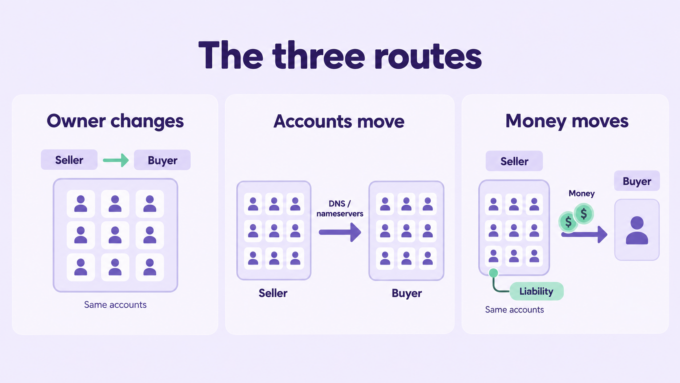
Route one: the account changes owner, nothing moves
If you and the buyer are with the same provider, the reseller account itself can change hands. Ownership and billing move to the buyer; the accounts stay exactly where they are. No migration, no DNS change, no re-issued certificates, no mail resync, no window at the weekend. Clients see nothing, because nothing happened to their sites.
It’s the best outcome available in a hosting sale and it’s chronically under-asked-for. Ask both providers what an ownership change involves before you assume a migration is the only option.
At ChemiCloud, to be specific about our own side of it: transferring a reseller account to a new owner is free, takes minutes, and needs nothing beyond verification of both parties. The bundled WHMCS or Blesta licence goes with the account. Existing pricing and plan terms are honoured to expiry, so a legacy or promotional rate isn’t quietly repriced on the buyer. Retained backup history stays intact. Moving accounts between two reseller accounts instead — an internal migration — is a chargeable request at $10 per cPanel account (September 2026), which on a hundred-account book is a four-figure line item somebody has to agree to pay.
One thing we don’t do, and assume the same of any provider: we take no part in the sale. We’ll change the owner of an account — we hold no escrow, adjudicate nothing, and have no view of your agreement, and nothing about the transfer changes what you owe your own clients. Whatever the two of you haven’t written down, nobody else is holding.
We’re also rarely asked for this — most internal moves we see are resellers rebalancing their own accounts, not books changing hands. Treat it as a route you request by name rather than one anybody will offer you.
Route two: the accounts migrate to the buyer
The common case, because the buyer usually already runs their own environment.
At book level: agree the batches, drop TTLs in advance, move in groups, re-issue certificates, check mail thoroughly — it’s the thing that breaks — verify each batch before starting the next, and co-ordinate the migration with the billing cut-over so nobody gets invoiced twice or not at all. Per-site mechanics are a separate job: migrating client sites to your reseller account covers moving one site without downtime.
Two facts belong in the price negotiation rather than the migration plan. A migration costs money per account, including between two accounts at the same provider. And backup history doesn’t travel: restore points start again when the accounts arrive, so for the first cycle the book has no recoverable history at all. Backups, and who’s responsible when a client deletes their site covers what the buyer should have running by day two.
Route three: the buyer runs your account (don’t)
The informal version: the buyer pays you, takes over the clients, and the account stays in your name because it’s easier.
It is easier, for about four months. You remain the account holder of record — liable to the provider for accounts you no longer earn from and no longer control, holding the payment method that keeps them online, and named on whatever your clients agreed to. There’s no clean ending, and no provider will arbitrate it for you. If it’s unavoidable as a transition step, it needs an end date in writing and a named event that triggers the change.
The nameserver question
This one catches almost everybody. If your clients point at ns1.yourbrand.com, those nameservers sit on a domain you own, and there are only two outcomes.
Either the brand domain is part of the sale — in which case decide whether the buyer trades under your name, for how long, and what happens to your email on that domain — or every client’s DNS has to change, which turns a silent handover into a visible one and puts the slowest item in the project on your critical path. Neither is wrong; discovering the question exists in week three is. White-label hosting: where the seams actually show covers what the client can see either way.
A third option is worth knowing about: some providers will run two reseller accounts on the same private nameservers even when the accounts belong to different people. That makes a phased handover practical — part of the book now, the rest after a retention measurement — with no DNS change per batch and no flag day. Ask before you design the deal around a single cut-over.
Preparing the book: the six months before you list
The highest-return work available to you, and none of it is negotiation.
- Standardise onto a small number of packages — how many hosting tiers you should offer is the same decision a buyer would make.
- Bring legacy prices toward current, early, and not in the quarter you hand over.
- Consolidate onto one billing platform, with auto-renewal wherever clients allow it.
- Resolve the free and favour accounts. Convert, end, or exclude them in writing.
- Separate hosting from retainers where the two are bundled.
- Write down the procedures that only exist in your head: provisioning, onboarding, backups, the annual domain renewals.
- Verify that backups restore. Not that they run — that they restore.
- Assemble three years of revenue, renewal and account-count history.
- Move support off your personal channels onto an address the buyer can inherit.
- Stop doing unbilled work the buyer won’t do.
Finding a buyer, and what they’ll ask to see
The buyer is usually closer than sellers expect. In rough order of likelihood: another operator in your own network — the agency that refers you work, a peer host, the local IT company; a competitor in your area or your niche; a larger reseller consolidating; and, at the far end, a broker’s buyer.
Be clear-eyed about that last one: a book this size is usually below the threshold where a broker’s fee makes sense for either side, which is why so much of what you’ll read about selling a hosting business doesn’t describe a transaction you’ll recognise. The realistic channels are a direct approach to people you already know, the industry forums where hosting books get listed, and general marketplaces last.
One caution about competitors: you’ll be disclosing client counts, revenue and eventually names to someone who could approach those clients instead. That’s what a non-disclosure agreement is for, and why disclosure runs in stages — shape of the book first, details after an agreement in principle.
A serious buyer will then ask for three years of revenue and renewal history, account counts over the same period, the resource footprint of the book, support volumes, whatever contracts and terms exist, and a list of everything non-standard. That’s the same list as the previous section — so a seller who can produce it in a day is negotiating from a different position than one who needs three weeks.
Structuring the deal
You probably have no adviser on a deal this size, so here is what to hold out for and what to push back on. Get the document itself drafted by a lawyer; it’s the cheapest part of the transaction.
Terms worth insisting on
- A written asset purchase agreement, however small the deal.
- Payment split across signing and a retention measurement at ninety or a hundred and eighty days, with the method in the document: which accounts count, what counts as a departure, who verifies.
- An explicit treatment of prepaid annual terms — money you’ve already collected for service the buyer will deliver, normally settled as a pro-rated adjustment at closing. It’s usually the largest number nobody discussed.
- A defined transition period with an end date and a stated scope.
- Escrow or staged payment for anything large enough to hurt.
- Clarity on which liabilities stay with you.
Terms worth refusing
- An unbounded non-compete. Narrow it: to hosting, to a period, to the clients being sold. You shouldn’t be signing away your ability to build someone a website in three years.
- Open-ended free support after the handover. It becomes a job you’re not paid for.
- A retention clawback you can’t influence or verify — particularly one where the buyer’s own service failures reduce your price.
- A price entirely contingent on future performance. Some contingency is reasonable; all of it means you’ve sold on credit.
- Any structure where the accounts move before any money does.
The handover is where the clients are lost
A sale can be clean on paper and still arrive at ninety days with a slice of the book gone. That’s not bad luck, and mostly not the buyer’s service. It’s three things, two of them preventable.
The payment details problem
Stored payment methods generally do not transfer between merchant accounts. The buyer’s billing system will need clients to enter card details again — and every renewal that requires a human to do something is a renewal that can fail.
This is the mechanism behind most post-sale attrition, and it’s why a retention holdback measured after the first full renewal cycle is measuring the right thing.
Handle it deliberately. Re-enrolment happens before the handover completes, as part of the announcement, not after the first invoice bounces. The buyer needs a dunning sequence ready before the first billing run — non-payment, suspensions and getting paid covers what that looks like — and someone watching the first renewal cycle daily, because a failed card in week one is recoverable and one nobody noticed in week six is a lost client.
The announcement
Who says it: you. A client who hears it from you and then from the buyer has been handed over; one who hears from the buyer first has been sold. When: after signing, before anything changes, with enough notice to act on whatever you’re asking of them. What’s in it: what changes for them, who to contact, when it happens, and what to do — including entering payment details on the new system. Resist the urge to explain the transaction; the more explanation there is, the more it reads like something went wrong. The most valuable line is your endorsement of the buyer, and it takes one sentence. The same conversation from the buyer’s side is in telling existing clients you’re taking over their hosting.
The first ninety days
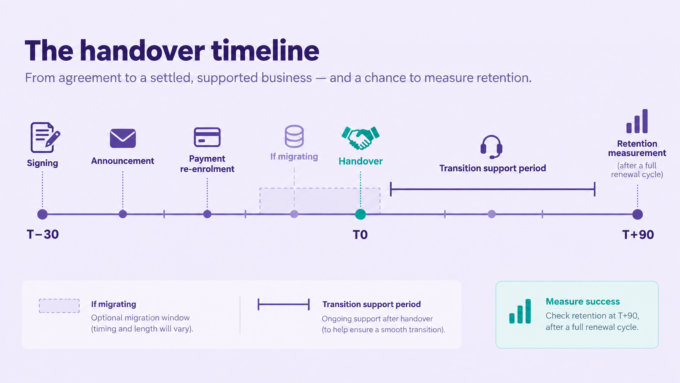
The buyer watches payment re-enrolment, the first full renewal cycle, ticket volume, and anything that looks like a cluster of departures in one segment.
If the book moved by migration, the first operational job is backups: history didn’t come with it, so the first verified restore point is one the buyer creates. Do it in week one.
You stay reachable, with a scope. Clients will email you anyway for months — forward them, and tell them once, kindly, that you have. If something breaks visibly, handling downtime: a communication plan matters more than usual here, because a client who has just been told their hosting changed hands will blame exactly that.
When selling isn’t the right ending
For a share of readers it isn’t. Four alternatives, all legitimate:
- Hand the book to another host for a referral or introduction fee. The right answer for a book too small or too entangled to sell properly. You’ll get less, and you’ll be done in a fortnight.
- Sell part of it. Keep the clients who are really design clients; sell the pure hosting accounts, the transferable part anyway.
- Keep it and stop growing. If the revenue is near-passive and your problem was growth rather than the operation, selling solves the wrong problem.
- Wind it down properly. Long notice, help finding new homes, clean exports, no surprises — a materially better ending for clients than a cancellation email, and for a book with nothing transferable behind it, the honest one.
If what you’ve outgrown is the plan rather than the business, that’s a different question — outgrowing reseller hosting covers it.
If you’re the one buying
Check the things the seller hasn’t thought about.
Tenure and renewal history before headline revenue. The resource footprint of what you’re taking on, against the plan that will hold it: account count, storage, and what those sites actually use. How many accounts are really one client. What the seller’s terms promise that you’ll inherit. How the payment details will move, which will decide your first quarter.
And what the route costs you. A free ownership transfer against a per-account migration fee is a real number on a hundred-account book, and it’s yours, not the seller’s. On a migrated book you inherit no restore history either — verify your own backups before you take the support inbox. Then invert the deal structure above: you want the holdback, the prepaid-term adjustment and the transition period at least as much as the seller does. How to price reseller hosting plans is worth reading before you assume the book’s existing prices are the ones you’ll keep, and what hosting support load actually looks like is the load you’re buying.
Mistakes worth avoiding
- Cancelling when you could have sold.
- Telling clients before the deal is signed.
- Taking the whole price at signing.
- Forgetting the clients who paid a year up front.
- Raising prices the month before a handover.
- Letting the accounts move before any money does.
- Agreeing a non-compete with no boundaries.
- Assuming the nameservers come with the accounts.
- Assuming a migration is the only way to move a book.
Frequently asked questions
Can I sell my hosting clients without telling them? You can complete the sale without telling them first — and you should, since deals collapse. You can’t complete the handover without telling them: there are data-protection obligations attached to handing their information to another company, and a client who finds out from an unexpected invoice is a client who leaves.
What happens to clients who paid a year in advance? You’ve collected money for service the buyer will deliver. It’s normally settled as a pro-rated adjustment in the buyer’s favour at closing. Raise it yourself rather than letting it surface in diligence.
Do I need the buyer to be on the same host as me? No, but it opens the cleanest route: the account can change owner with nothing migrating and nothing visible to clients. Otherwise you’re migrating, with the cost and the backup reset that involves.
What if I can’t find a buyer at all? Work out why. Usually it’s one of the discount items above, and six months fixes it. If it isn’t — the book is tiny, or the relationships genuinely can’t be separated from you — a referral arrangement with another host, or an orderly wind-down, is a better ending than letting it drift.
If you’re buying a book, the plan has to be sized for the accounts you’re taking on rather than the ones you have — compare account count and what those sites actually use, not the storage headline. Our reseller hosting plans are listed by both, and the reseller hosting profit calculator will tell you what the book earns at your prices rather than the seller’s.
If you’re selling and the page has convinced you that you’re not ready, the work is in Preparing the book — six months, not six weeks, and worth starting before you have a buyer rather than after.