Live Chat
 Help Center

Reselling hosting looks like the easiest margin in the business: buy a reseller plan for the price of two coffees, sell forty accounts on top of it, keep the difference. The arithmetic is real. What most articles leave out is the second half of it — the hours, the churn, the invoices that don’t clear — which is where the actual answer lives.
The short version: a designer moving 15 existing clients onto a reseller plan at $25/month is looking at roughly $310 a month in gross margin from the first month, before their own time. Someone starting from zero with no audience is realistically looking at 15–20 accounts and about $250 a month by month twelve. The gap between those two numbers is not effort or skill. It is whether you already have the customers.
This article shows both calculations in full, with every assumption on the table so you can argue with them. It’s one step in the wider process covered in how to start a reseller hosting business; if you want the mechanics of what reseller hosting actually is first, start with what is reseller hosting.
Pick your starting point:
- You already have clients → jump to “Scenario A” section below.
- You’re starting from zero → jump to “Scenario B” section below.
Table of Contents
- The short answer, with the conditions attached
- The four numbers that decide everything
- The full cost stack
- Scenario A: you already have 15 clients
- Scenario B: you’re starting from zero
- Run your own numbers
- What a healthy reseller business actually looks like
- Five ways the numbers go wrong
- When reselling isn’t worth it
- What to do next
- Frequently asked questions
The short answer, with the conditions attached
Every figure in this article comes out of one formula:
Monthly profit = (accounts × price) − plan cost − tooling − payment fees − (support hours × your hourly rate)
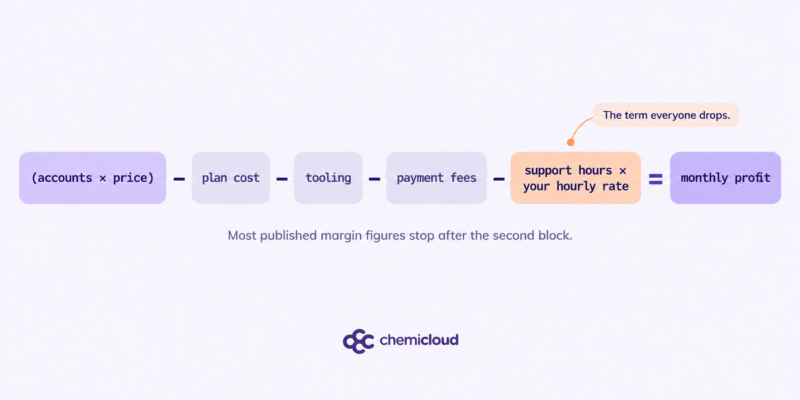
The last term is the one that gets dropped. Almost every “reseller hosting profit margin” figure you’ll find online — the 70%, 80%, 90% numbers — is calculated as revenue minus plan cost, and stops there. That figure is not wrong so much as useless: it describes a business with no operator in it.
If your time has a market price, hosting has to clear it. A designer billing $75 an hour who spends four hours a month on hosting support has spent $300 to earn $310. That is not a disaster, but it is a completely different business from the one the 90% margin implies, and it explains why so many people resell for two years and can’t say whether it made them money.
One qualification that cuts the other way, and it matters: if you already answer “my site is down” calls for free, those hours are not new. Taking over hosting doesn’t add them, it puts a price on them. Count only the hours hosting genuinely adds. For most designers with an existing book, that’s a fraction of the total.
Throughout, examples use US dollars and a $75/hour billable rate — a middling freelance design rate. Substitute your own; the shape of the answer doesn’t change, only the crossover points.
The four numbers that decide everything
Everything else is rounding.
1. Price per account
What you charge, per site, per month. The realistic range is wide: $8–15 for hosting sold as a commodity to price-shopping strangers, $20–40 for managed hosting sold to existing design clients who are buying reassurance rather than disk space.
The single most common mistake is pricing against Bluehost for instance. Your client is not choosing between you and Bluehost; they are choosing between you and figuring it out themselves. That’s worth considerably more than $3.99. Setting the number properly is its own subject — see how to price reseller hosting plans.
2. Cost per account
Your plan cost divided by the accounts you actually place on it. On a $45.95 plan with 15 accounts, that’s $3.06 per account. On the same plan with 50 accounts, it’s $0.92.
This is why the margin looks so good in the abstract — the cost per account falls away to nothing. The limit isn’t the account cap on the plan; it’s what the plan’s resources can carry without your clients noticing. “Unlimited accounts” is a licensing statement, not a physics one. See overselling: what it is and when it’s defensible for where that line sits.
3. Churn
The percentage of accounts you lose per year. Assume 10–20% annually for hosting sold to design clients you already have a relationship with, and meaningfully more for hosting sold cold — the profit calculator defaults to 18%, which sits between the two.
Treat that as a working assumption rather than a finding. Churn behaves differently at small scale anyway: at 15 accounts, churn isn’t a rate, it’s Dave, who sold his business. Two departures in a quarter is a 50% annualised churn rate and also just a bad quarter.
4. Your support hours
Hours per month spent on hosting that you would not otherwise have spent. Budget 10–15 minutes per account per month for small business sites, plus an hour or two of fixed overhead for billing, monitoring and the occasional platform-wide problem.
It doesn’t scale linearly. Twenty accounts is not four times the work of five, because most of the load is a small number of clients who need a disproportionate amount of hand-holding. It also isn’t flat — at some point you cross from “answer it when it arrives” into “be reachable”, and that transition is expensive.
The full cost stack
Here’s everything, including the lines that don’t appear on your hosting invoice. Costs shown are for a small reseller running 15–30 accounts.
| Line item | Typical monthly cost | How it scales | Usually forgotten? |
|---|---|---|---|
| Reseller plan | $18–50 | Steps up at plan boundaries | No |
| Billing software | $0–13 | Flat until client count crosses a licence tier | Sometimes |
| Payment processing | ~2.9% + $0.30 per invoice | Linear with invoices, not revenue | Yes |
| SSL certificates | $0 | Included on most reseller plans | No |
| Backups | $0 | Included on most reseller plans | No |
| Domain registrations | Pass-through | Only if you resell domains | No |
| Migration labour | One-off, 20–60 min per site | Front-loaded, then gone | Yes |
| Support time | 10–15 min per account | Sub-linear, then steps | Yes |
| Non-payment write-offs | 1–3% of revenue | Linear | Yes |
| Refunds and chargebacks | Occasional | Lumpy | Yes |
The first four lines are predictable and trivially small. The last four are where the margin actually goes, and none of them appear in a plan comparison table.
Payment processing deserves a moment because it’s counter-intuitive: it scales with the number of invoices, not their size. Fifteen invoices at $25 costs about $15.40 to collect. One invoice at $375 costs about $11.20. Annual billing is worth roughly a percentage point of margin, and it collapses your churn exposure at the same time.
Billing software is worth checking carefully, because the sticker price and the real price diverge. A WHMCS Starter licence runs $12.95/month as a standalone add-on — but it’s included at no cost on ChemiCloud’s Grow plan and above, while the cheaper Kickstart plan includes Blesta only. That inverts the obvious choice: Kickstart at $17.95 plus WHMCS at $12.95 is $30.90, against Grow at $19.95 with WHMCS included. The cheaper plan is the more expensive plan. Note that the included Starter tier carries WHMCS branding in the client area; if that matters, budget for the tier above, and see where the seams show in white-label hosting. For the platform decision itself, see WHMCS vs Blesta.
Non-payment is the line most people discover late. A percentage of clients will simply stop paying, and the awkward part is that you now control something they need. Non-payment, suspensions and getting paid covers how to handle that without torching the relationship.
Scenario A: you already have 15 clients
The most common starting position, and the one with the best economics by a distance. You’re a freelance designer or a small studio. Fifteen active clients, all with WordPress sites you built, all currently paying somebody else $10–30 a month for hosting.
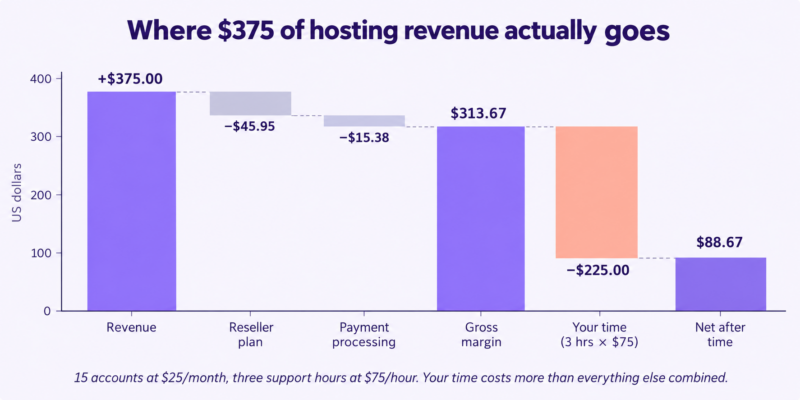
Assumptions: 15 accounts at $25/month. Grow plan at its $45.95 list rate (the promotional first-term rate of $19.95 saves about $312 in year one — real money, but don’t build a business on it). WHMCS included. Payment processing at 2.9% + $0.30 per invoice, billed monthly. Three hours a month of support, all of it genuinely additional. Your time at $75/hour.
| Monthly | Annual | |
|---|---|---|
| Revenue (15 × $25) | $375.00 | $4,500 |
| Reseller plan | −$45.95 | −$551 |
| Billing software | $0 | $0 |
| Payment processing | −$15.38 | −$185 |
| Gross margin | $313.67 | $3,764 |
| Your time (3 hrs × $75) | −$225.00 | −$2,700 |
| Net after time | $88.67 | $1,064 |
| Effective hourly rate | $105/hr |
That effective hourly rate is the number to look at, and it’s the reason this works: $105 an hour against a $75 billable rate. Hosting is paying better than your design work, per hour spent, at fifteen clients.
What happens when not everyone moves
They won’t. Some clients are locked into annual plans, some have a nephew who handles it, some just say no. Here’s the same business at three levels of take-up:
| All 15 move | 11 of 15 move | 11 move, one lost per quarter | |
|---|---|---|---|
| Accounts (avg) | 15 | 11 | ~9 |
| Revenue | $375 | $275 | $225 |
| Gross margin | $314 | $218 | $170 |
| Support hours | 3.0 | 2.4 | 2.0 |
| Effective hourly | $105 | $91 | $85 |
| Annual gross | $3,764 | $2,613 | $2,040 |
The economics degrade gracefully — even the pessimistic column beats your billable rate — but the trend line in column three is the thing to watch. At this scale you are not managing a churn percentage, you are managing nine relationships. One phone call fixes more than any retention campaign. Why hosting clients leave goes into what actually drives departures.
Two things this table doesn’t capture, both of which favour doing it:
Retention. A client whose hosting, domain and site all sit with you does not casually drift to another designer. Nobody has a good number for what that’s worth, but every agency that’s done it will tell you it’s larger than the hosting margin.
Asset value. Recurring revenue with low churn is a saleable thing. A book of 40 hosting clients at $25/month has a market value in a way that 40 hours of design work never will. See selling a hosting book of business.
The case for doing this at all, beyond the money, is in should web designers resell hosting to their clients?.
Scenario B: you’re starting from zero
Different business. Same formula, much worse inputs, and the honest version looks like this.
Assumptions: $15/month per account — you’re selling to strangers who are comparing you against advertised prices, so you can’t hold $25 yet.
Grow plan at the $19.95 introductory annual rate for year one. Two new customers a month from month two, with churn starting around month five. No existing audience.
| Month | Accounts | Revenue | Plan + fees | Net cash |
|---|---|---|---|---|
| 3 | 5 | $75 | −$23.63 | $51 |
| 6 | 10 | $150 | −$27.30 | $123 |
| 9 | 14 | $210 | −$30.24 | $180 |
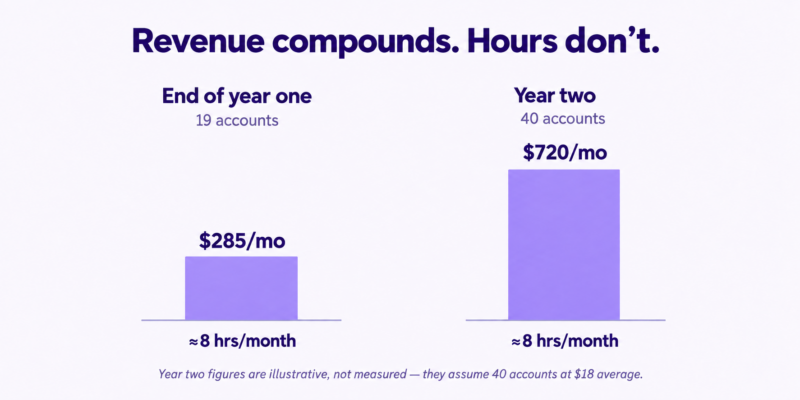
| 12 | 19 | $285 | −$34.92 | $250 |
Cash breakeven arrives in month two, which sounds encouraging and mostly isn’t — the plan is cheap, so covering it proves very little. Year one nets roughly $1,450 in cash. Against something like 90–100 hours of setup, support, site building and marketing, that’s around $15 an hour.
The month-four problem
Month four is where people quit, and the table shows why. The novelty is gone. You have seven customers, you’ve answered your first genuinely irritating support ticket, the plan renewal is visible on the horizon, and the compounding hasn’t started. On an hourly basis you are being paid badly to do work you didn’t know you’d signed up for.
The people who get through month four are the ones who understood what they were buying. From zero, reseller hosting is not income — it’s an asset you build with unpaid hours, which starts paying somewhere in year two when the client base compounds and the hours don’t. Year two at 40 accounts and $18 ARPU is $720 a month against maybe six hours; that’s the business the year-one grind buys.
If you need money this quarter, this is the wrong vehicle and no amount of good execution will change that. If you’re building something over three years, the numbers work — and they work considerably faster if you sell to a niche rather than to everyone, because acquisition is the binding constraint here, not margin. See finding your first hosting clients and why niche hosting beats generic hosting.
Run your own numbers
The scenarios above are built on stated assumptions that are unlikely to be yours. The reseller profit calculator runs the same formula against your figures.
Have these five things to hand before you open it:
- [ ] How many clients you have, and how many currently host elsewhere
- [ ] What they pay for hosting now — ask two of them, don’t guess
- [ ] Your billable hourly rate, or your honest opportunity cost
- [ ] Hours per week you can realistically commit to support
- [ ] The monthly figure that would make this worth doing
That last one matters most. “More money” is not a target, and without a number you can’t tell whether the answer the calculator gives you is a yes.
What a healthy reseller business actually looks like
Three stages, with the figures that tend to accompany each. These are modelled from the assumptions in this article rather than measured across a population — treat them as a ruler, not a benchmark.
| Stage | Accounts | ARPU | Monthly revenue | Hours/week | Net after time |
|---|---|---|---|---|---|
| Side project | 5–20 | $10–20 | $75–400 | <1 | Thin to negative |
| Real second income | 25–60 | $20–30 | $600–1,700 | 3–5 | $400–1,200 |
| Primary business | 100–250 | $25–40 | $3,000–9,000 | 15–25 | Needs help to hold |
Two things to take from this. The first is that the interesting territory starts around 25 accounts — below that, the fixed overhead of running a hosting operation isn’t spread over enough revenue to be worth the trouble unless the accounts came free with clients you already had.
The second is that the third row is a different job. At 150 accounts you are running a hosting company: someone has to be reachable, someone has to answer at 11pm, and that someone is you until you hire or leave. Plenty of resellers decide the second row is the right place to stop. That’s a legitimate destination, not a failure to scale.
Five ways the numbers go wrong
Underpricing at launch. The most expensive mistake available, because it’s the hardest to reverse. Every subsequent price rise is a conversation with an existing client, not a decision. Start higher than feels comfortable. If you’re already stuck low, raising hosting prices on existing clients is the way out.
Overselling and paying for it in churn. Packing accounts onto a plan improves cost per account right up until sites get slow, at which point you’ve bought a small saving with your retention rate. The saving is a few dollars. The churn is not.
Unbounded free support. “I’ll just fix it” is a fine instinct and a terrible business model. Uncounted hours don’t show up in any table, which is exactly what makes them dangerous — the margin looks great right up until you work out what you earned per hour.
Hosting buried inside a retainer. Convenient to sell, impossible to measure, and when the retainer gets renegotiated the hosting margin quietly goes with it. Hosting inside a retainer vs billed separately covers both sides.
No terms of service. Without written terms you have no basis for saying no to the client whose “small favour” is a four-hour migration, and no procedure for the one who stops paying. Terms of service and AUP for a small host.
When reselling isn’t worth it
Some honest disqualifiers. If you recognise yourself here, the answer is no, and the alternatives are better:
- Fewer than about 8–10 sites and no path to more. The overhead isn’t worth spreading over five accounts. Refer clients to a host with an affiliate or agency programme and take the commission with none of the liability.
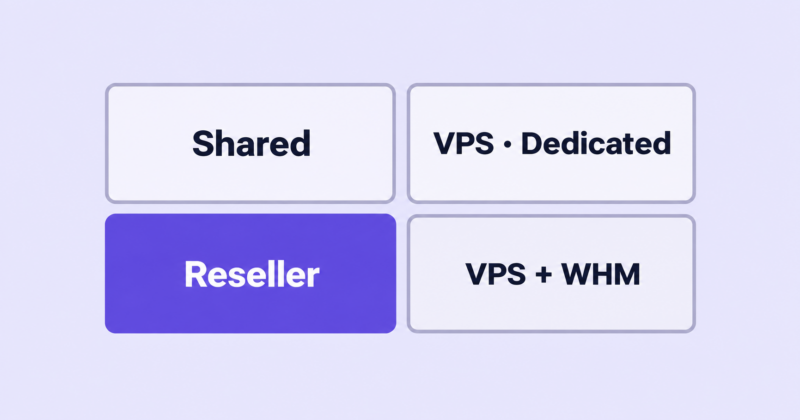
- Clients on stacks that don’t fit shared hosting. Heavy applications, unusual runtimes, strict compliance requirements. Reseller hosting is the wrong shape; look at reseller vs shared vs VPS vs dedicated.
- You don’t want to be reachable. Hosting is an availability business. If a client site going down on a Sunday would ruin your week rather than your afternoon, that’s a real constraint and worth respecting.
- Your practice is already at capacity. If you’re turning down billable work, three hours a month at $105 is worse than three hours at your day rate plus no on-call obligation. Hosting is worth doing when you have capacity to spare or clients you want to hold, not when it competes with better-paid work.
What to do next
If you have clients already, the highest-value next step is setting your price — every figure in Scenario A moves with it, and it’s the one input you fully control. If you’re starting from zero, read the pillar guide end to end before spending anything.
Either way, run your own version of the arithmetic in the reseller hosting profit calculator rather than trusting the examples here.
And when you’re comparing plans, check three things beyond the headline price: how many accounts the plan actually carries, whether billing software is included or extra, and what the renewal rate is once the introductory term ends. ChemiCloud’s reseller hosting plans list all three, along with free migrations if you’re moving an existing book of client sites across.
Frequently asked questions
Is reseller hosting still profitable in 2026?
Yes, but not as a standalone product sold on price. The margin is healthy — typically 80%+ before your own time — and the businesses that work are the ones bundling hosting with a service clients already buy. Selling commodity hosting against advertised prices is a hard business and always has been.
How many clients do you need to make it worthwhile?
Around 8–10 to justify the overhead, 25+ before it’s a meaningful second income, and 100+ before it can be a primary business. If the accounts come attached to design clients you already have, the lower end works from day one because the acquisition cost is zero.
What profit margin is realistic?
Gross margin of 80–90% is normal and largely meaningless. The number that matters is net after your own time, which at small scale is often close to zero — and an effective hourly rate that should beat whatever else you’d do with those hours. Scenario A above works out at about $105 an hour.
How much time does supporting hosting clients take?
Budget 10–15 minutes per account per month for small business sites, plus an hour or two of fixed overhead. Expect it to be concentrated: a handful of clients will generate most of the load, and a platform incident will cost you a day regardless of how many accounts you run.
Is it better to bill hosting separately or inside a retainer?
Separately, in almost every case. Bundled hosting is easier to sell and impossible to measure, and it disappears the first time the retainer is renegotiated. Full comparison here.