Live Chat
 Help Center

If you sell hosting, or you’re about to, sooner or later someone tells you to pick a niche. (If you’re a business looking for a host that understands your industry, this is the wrong page — it’s written for the person on the other side of that sale.)
So you have one written down. It probably came from an article ranking for the most profitable hosting niches. Every one of those articles tells you which industries have money. Not one tells you how you get into a room with one.
Specialising does beat selling to everybody, but not for the reason it’s usually sold. It wins because in a niche your second client comes from your first, and because the same three problems keep arriving until you’re fast at them. The price premium is real and it turns up last. So you choose on reach, not on margin: a niche you can’t get introduced into is a slogan, not a channel.
The whole sequence around this decision is in how to start a reseller hosting business; if the model itself is still fuzzy, what is reseller hosting covers it. And if you already build or maintain sites for clients, you have a niche — it’s the work you already do. Should web designers resell hosting to their clients is your version of this argument.
Table of Contents
- The short answer
- What a niche actually buys you
- Choosing a niche you can actually reach
- Niches that look better than they are
- When generic is the right answer
- What changes when you specialise
- The risk nobody mentions: a niche is a correlated book
- Testing a niche in ninety days
- Retrofitting a niche onto the clients you already have
- Mistakes worth avoiding
- Frequently asked questions
The short answer
- A niche is a distribution channel, not a headline. If you can’t get introduced, it isn’t one.
- The benefit that arrives first is referral. The benefit that arrives last is price.
- Choose on access: twenty you could name, a place they gather, three problems you can describe.
- Niching is a positioning decision, not a policy. You point your copy at one group. You don’t refuse everyone else.
- A niche is a correlated book. The concentration that makes selling easy is the same concentration that makes a bad year arrive all at once.
Three readers should leave this for later. If you have fewer than three clients, specialisation isn’t your problem — nobody has bought anything yet, and finding your first hosting clients is the page for that. If your only route to clients so far is people you already know, work that list before you narrow it; the niche you eventually pick is usually hiding in it. And if the niche you’re weighing appears in the list further down, the margin isn’t worth what comes attached.
What a niche actually buys you
Four things, and they arrive in a fixed order. Expecting them in the wrong order is why people abandon a niche at month three, about a fortnight before it starts working.
Referral inside a group — immediate
Businesses in one industry know each other. Unrelated businesses don’t.
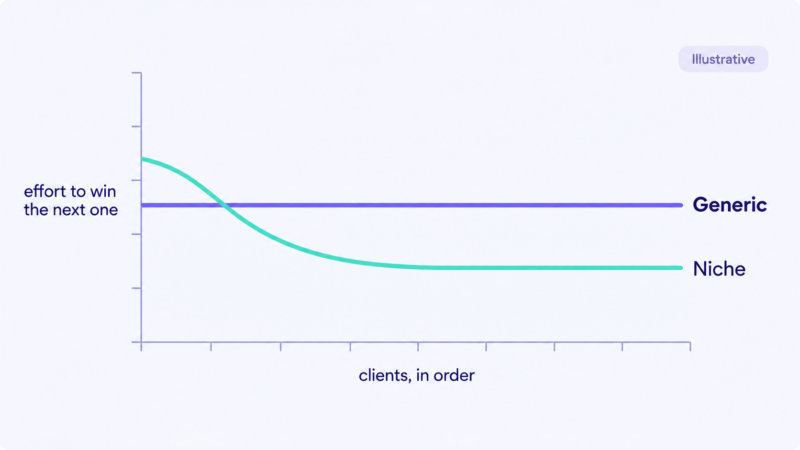
A satisfied plumber and a satisfied dental practice are two references. Two satisfied dental practices are a reputation inside a group that talks — at the same conferences, in the same association newsletter, through the same equipment supplier. That is the whole argument compressed: in a niche, the second client is cheaper than the first. In generic hosting, every client costs the same as the one before.
Turning that into actual conversations is a separate job, and finding your first hosting clients covers the routes. The point here is only that the routes get cheaper each time you use them inside one group.
The same problems, twice — months two to twelve
This is the benefit nobody writes about and the one that decides whether you can stand running this business at thirty clients.
Twenty similar businesses generate a small, repeating set of tickets. The same booking plugin. The same form vendor emailing from the wrong address. The same two things that break after an update. The first time, it’s an evening. The third time, it’s ten minutes and you knew what it was from the subject line. Support time per account falls while the account count rises, which is the only lever that makes a one-person host’s economics work as it grows — what hosting support load actually looks like goes into the shape of that load.
Run it the other way and you can see the cost: twenty unrelated sites on twenty stacks is genuinely harder work than thirty similar ones, and no amount of process fixes it.
A package that fits without asking — six to eighteen months
Once the sites look alike, one package covers nearly all of them. The same resource allocation, the same PHP version, the same backup cadence, the same handful of things preinstalled. Onboarding becomes a checklist instead of a conversation. Quoting stops involving a survey.
What goes on that package, and how many of them you publish, is its own decision — how many hosting tiers you should offer and how to create hosting packages in WHM handle the design and the mechanics.
Pricing power — last, and smaller than you’ve been told
A specialist is harder to price-compare, because there’s nothing obvious to compare them against. A client who believes you understand their setup isn’t checking your monthly rate against a budget host, because they’re not buying the same thing. That’s real.
It’s also worth less in your first year than the referral effect, and it doesn’t survive anyone claiming a specialism they don’t have. Two clients in an industry is not expertise; it’s two clients. The number itself comes out of your costs rather than your positioning — how to price reseller hosting plans builds it, and how much you can make reselling web hosting is the wider picture.
Choosing a niche you can actually reach
The question isn’t which niche is most profitable. It’s which niche will answer the phone.
The five axes, and why the good ones cross two
| Axis | What it looks like | Why it works | Where it fails |
|---|---|---|---|
| Industry or trade | Dental practices, law firms, plumbers, driving schools | They talk to each other and share suppliers | Nothing to say if you’ve never worked with one |
| Platform or stack | WordPress only, WooCommerce, one CMS, one page builder | Support repeats, so you get fast quickly | Too broad alone — “WordPress” isn’t a niche |
| Geography or language | One city, one region, one language | Introductions are easy and being local is a real difference | Caps out at the size of the area |
| Site type or business model | Membership sites, booking-driven sites, charities, event sites | Cuts across industries, so the pool stays large | Harder to find where they gather |
| Channel or partner | Designers, an agency network, a franchise, an association | Clients arrive in batches rather than singly | Concentration risk — one relationship, many accounts |
The workable niches are usually two of these crossed. WooCommerce stores in one country. WordPress sites for trades in one metro area. Booking-driven sites for clinics. One axis on its own is either too broad to be a channel or too small to be a business.
The access test
Eight questions about the niche you’re considering. Answer them honestly; it takes about ninety seconds.
- Can I name twenty of them without opening a search engine?
- Do they gather somewhere — an association, a trade body, an online group, an event, a supplier they all use?
- Can I describe three website problems they have, specifically?
- Do they already pay someone for something website-shaped?
- Can somebody introduce me, or do I have to buy attention?
- Will their sites run inside one hosting account on my plan?
- Would I be content answering their questions for the next three years?
- Is someone already the obvious specialist here — and if so, what’s left?
The pass rule: you need a yes to #1, a yes to #2 or #3, and a yes to #6. That’s it.
A niche whose only yes is #4 — they have money — is a niche you got from a list, and it’s the one that produces three months of silence and a conclusion that niching doesn’t work. A no to #7 is worth taking seriously too. You’re choosing the conversations you’ll be having for years, not just the invoices.
Question 6 deserves a minute of arithmetic rather than a guess. Whatever niche you pick, its sites have to run inside a single cPanel account on your reseller plan, and that envelope is set by your provider rather than by you. On ChemiCloud’s reseller hosting plans that means a defined memory and CPU allocation per cPanel account, a PHP range wide enough to cover both elderly and current sites with per-account selection, and the usual plumbing — cron, SSH, Redis, WP-CLI. What it also means is that raising the ceiling for one demanding client is a paid add-on, not a dial you turn yourself. So a niche built on heavy sites carries a per-account cost that a niche of brochure sites doesn’t. Do that sum before you commit to the niche, not after the third client complains the site is slow.
Where your niche is probably already sitting
If your answer to all of this is that you don’t know anyone in any industry, look in four places before concluding you have no options.
The job or trade you did before this. The industry of a past employer, or a family business. A community, club or association you already belong to. And the accidental cluster already sitting in the clients you have — most people with a dozen clients have three of one kind without having planned it.
Prior standing in a group beats industry attractiveness, because standing converts into introductions and attractiveness doesn’t. And geography is the fallback that’s always available: you live somewhere, and local is a niche with a door already open.
Niches that look better than they are
None of these are forbidden, and several are good businesses for a host with a team, an abuse desk and a payment processor that knows them. They’re poor first niches for one person on a reseller account, for reasons that are operational rather than moral.
Abuse-adjacent work — bulk email, link networks, anything whose business model is volume outbound. Your provider’s acceptable use policy reaches your clients through you: when something goes wrong, the account gets dealt with and you’re the one held responsible for it. Terms of service and AUP for a small host covers what you need in writing before you take on work like this, and when a client site gets compromised covers the morning after.
Crypto, gambling and adult — the listicle favourites, and the ones where the margin is advertised loudest. Higher chargeback exposure, payment processing that gets harder over time rather than easier, and an abuse and support profile a one-person operation absorbs badly. Provider policies on these differ, so read your own before you build a business on top of one.
Resource-heavy site types — video-led sites, large course platforms, membership sites with deep plugin stacks, big product catalogues. These are real businesses and they’re expensive accounts. Work out what one costs you to run, and what the add-on to give it more headroom costs, before you decide this is your niche: the reseller hosting profit calculator will tell you what that does to your margin at twenty clients.
Industries that fail together — hospitality, events, anything strongly cyclical or dependent on a single funding source. See the next section.
Industries being eaten by a platform — restaurants absorbed by ordering platforms, trades by directory-built sites, small retail by hosted storefronts. Not a reason to rule them out, but know what your client’s alternative is and why a site of their own still earns its place.
Buyers who expect assurances you can’t give — sectors where procurement routinely asks about data handling, certifications or audit trails. If a niche’s standard question is one you can’t answer honestly, it’s the wrong first niche.
The two non-niches — “small businesses” and “WordPress users”. Both are markets, not channels: there’s nowhere to go and nobody to be introduced by. WordPress crossed with an industry or a place is a niche. WordPress on its own is just what you use.
When generic is the right answer
Three cases, and they cover more readers than the rest of this article admits.
You’re under five clients and your list isn’t exhausted. Go and work it. A niche discovered by selling to people you know arrives with clients already attached, which is strictly better than one chosen in advance.
Your distribution is local and personal. A one-person host looking after thirty unrelated businesses in one town already has a niche — the town — and adding an industry filter would remove clients without adding a channel.
You’re a designer or developer with a book of work. Your niche is the work. Narrowing it to an industry is optional, and later. Whether hosting sits inside your retainer or on its own invoice matters more — hosting inside a retainer vs billed separately is that decision.
What doesn’t work is none of the above: no warm list, no specialism, and a plan to serve everyone equally well. That position is already occupied by budget hosts, at prices you can’t match and shouldn’t try to.
What changes when you specialise
If nothing on this list changes, you haven’t niched — you’ve just changed your homepage.
Your package. One specification instead of three guesses at what people might want, built around what this kind of site actually uses rather than around what sounds generous.
Your onboarding. A checklist, because the setup is the same every time — and a checklist you can hand to someone else later, which a bespoke setup never is.
Your migrations. The same source hosts, the same plugin set, the same three surprises — migrating client sites to your reseller account gets faster each time rather than staying an adventure.
Your support. Three saved answers cover most of what arrives in a week.
Your referral ask. “Let me know if you hear of anyone who needs hosting” becomes “do you know another practice whose website nobody’s really looking after”. The specific version is the one that gets answered.
What you won’t host. Specialising makes your exclusions obvious, and obvious exclusions belong in writing.
One more, worth a sentence: a niche gives you search terms you can realistically compete for, which the head hosting terms never will be. That’s a year-two asset, not a source of your first client.
The risk nobody mentions: a niche is a correlated book
The concentration that makes your fifth client cheap is the same concentration that means a bad quarter for the industry is a bad quarter for all of your revenue at once. Every article recommending niches skips this. Three things blunt it.
Prove one niche before adding a second, and make the second adjacent. Adjacent keeps the repeat-support advantage you built the business on. Unrelated gives you two of everything and the benefits of neither.
Don’t let one door be the only door. If every client came through one association or one agency partner, the relationship is your risk, not the industry.
Assume departures arrive in clusters. One platform change or one industry shock moves several accounts in the same month rather than one a quarter, and why hosting clients leave is worth reading before it happens. The terms, notice periods and billing arrangements that survive that are worth having in advance — including for the version where clients stop paying rather than leaving cleanly.
Testing a niche in ninety days
Treat this as an experiment with three clients in it, not a commitment. Pick one niche and one place they gather. Talk to ten of them. Take three as clients. Write down every question they ask you.
Signals it’s working:
- The second client came through the first. This is the one that matters most — it’s the entire thesis, and it’s observable inside ninety days.
- The third ticket looked like the first.
- You could write their package specification without asking them anything.
- They asked what you do before they asked what you charge.
Signals it isn’t:
- Every client needed a bespoke setup.
- No introduction ever happened, and you never found where they gather.
- The work is fine, but you’d rather not do it for three more years.
If it’s the second list, you’ve lost ninety days and learned where not to spend the next twelve months. Almost everything you built carries over to the next attempt: the package, the checklist, the saved answers, the clients themselves. The only thing that was ever niche-specific was the copy.
Retrofitting a niche onto the clients you already have
If you’ve got eight to fifteen unrelated clients and things have gone quiet, you don’t need to start again.
- Find the accidental cluster. Three of one kind — same industry, same site type, same town. It’s already validated: those clients bought.
- Change your copy and your referral ask first. Cheapest change, fastest signal, reversible in an afternoon.
- Standardise that cluster’s package and leave everyone else alone. Nobody gets migrated or repriced because you’ve picked a focus — and if a price change is coming anyway, raising hosting prices on existing clients is its own decision with its own timing.
- Point the next twelve months at the cluster. The rest of the book stays exactly where it is.
Positioning, not policy. You’re not firing anyone, and you’re not turning away the plumber.
Mistakes worth avoiding
- Picking a niche off a list of profitable industries you have no access to.
- Treating a niche as a promise to refuse everybody else.
- Choosing a resource-heavy niche without doing the per-account arithmetic first.
- Choosing an abuse-adjacent niche for the margin.
- Building a separate brand and website before the third client.
- Calling yourself a specialist in something you’ve done twice.
- Letting one association or one partner be your only route in.
- Abandoning the niche at month three because the price premium hasn’t appeared yet.
- Picking a group you don’t actually want to talk to for the next three years.
Frequently asked questions
What is niche hosting? Hosting sold to one defined group — an industry, a platform, a place, a type of site — rather than to anyone who turns up. The part that makes it work is that the specialisation changes the package, the onboarding and the support, not just the marketing.
What’s the most profitable hosting niche? There isn’t one, and the question leads people somewhere expensive. No niche is profitable to someone who can’t get into it, and the gap between two niches you can reach is far smaller than the gap between a niche you can reach and one you can’t. Run the access test above on the group you already know something about.
Can I change my hosting niche later? Yes, and people routinely do. What carries over is everything operational — the package, the checklists, the saved answers, the clients. What doesn’t is the copy, which takes an afternoon. Treat the first choice as a ninety-day test rather than a commitment.
Do I need a separate brand for each niche? Not in your first year. One brand is easier to build a reputation with, and a single page describing what you do for that kind of business does the same job as a separate identity. Separate brands make sense once each one has clients and a reason to exist on its own.
You’ve got a group. What you need next is three of them — finding your first hosting clients is the routes, the first message and what to say when they ask why you cost more than $3 a month.
Before that second conversation, have a number. How to price reseller hosting plans builds one from what an account actually costs you, and specialists price differently from generalists for reasons worth understanding before you quote.
One thing worth checking as you decide: the niche decision and the plan decision meet in the same place. Forty brochure sites and fifteen heavy ones are very different loads on the same reseller hosting plan, and the account count and per-account resources are the figures to compare — not the storage headline.