Live Chat
 Help Center

Yes, if you already handle the client relationship, you have more than about ten active sites, and you can tolerate being interrupted. No, if hosting would be your first recurring-revenue product and you are hoping it turns into passive income. It won’t.
That is the whole answer, and most designers know which side of it they fall on before they finish reading the sentence. What they usually don’t know is what the work actually involves once the first invoice goes out: how many tickets arrive, what those tickets are about, who is liable when something breaks, and whether the money justifies any of it.
This page covers that. It is one of the decision guides in our reseller hosting guide, and it is written for people who already run a design business. If you want the mechanics of how reselling works first, start with what reseller hosting is and come back.
The short answer
Two variables decide this, and neither of them is technical.
The first is client count. Below roughly eight to ten active sites, the margin is too thin to pay for the attention it costs. Above twenty-five, it starts to matter. Above fifty, it is a real line of business.
The second is your appetite for interruption. Hosting turns you into the person who gets called when something is down. That call does not schedule itself around your design work. If the thought of it makes you tense, that reaction is data, and you should trust it more than any margin calculation.
Everything below is about working out where you sit on those two axes.
Five questions that decide it for you
Answer these honestly. There is no score to total up; question four does most of the work on its own.
- Do you already have a maintenance or retainer relationship with most of these clients? If yes, hosting slots into an existing billing relationship and an existing expectation of contact. If no, you are introducing both at once, which is much harder.
- When a client emails at 6pm on a Friday, do you answer — and are you at peace with your answer? Either reply is fine. What matters is that you already know what you do and don’t feel guilty about it. Reselling punishes ambiguity here.
- Could someone other than you restore a site from backup this week? If the answer is no, you are the single point of failure for every site you host. That is survivable, but it needs a plan before it needs a client.
- Do your clients already ask you for help with hosting problems, without paying you for it? This is the one that decides it for most studios. If you are already fielding “the site is down” and “my email stopped working” for hosting you neither control nor bill for, you are absorbing the cost of reselling while collecting none of the revenue. For you the question is not whether to take on new work. It is whether to get paid for work you are already doing.
- Are you willing to raise a price on an existing client’s invoice without apologising for it? Hosting prices move. Yours will need to, eventually. If that conversation is unthinkable, the margin will erode until the whole thing is a favour.
What actually changes about your business
You become the first phone call
Clients do not distinguish between the website, the hosting and you. They never have. The difference is that once your name is on the hosting, the ambiguity resolves in your direction by default.
Every slow page, every broken plugin, every “I can’t log in,” every content question routes to you first, regardless of what actually caused it. A meaningful share of what arrives will not be hosting problems at all. You will still be the one to work that out.
Email will be most of your support load
This surprises almost everyone. Web hosting sold to non-technical clients generates mail tickets, not web tickets.
The site sits there and works. The email does not: messages land in spam, a phone stops syncing after an OS update, someone’s assistant needs access, a newsletter blast gets the domain flagged, a client insists mail is broken when in fact they are looking at the wrong inbox. Email is the part of hosting that touches a client every single day, so it is the part that generates contact.
There are two workable responses and you should pick one deliberately:
- Take it on. Learn enough about deliverability, DNS records and mail client setup to handle the common cases quickly. Price for it.
- Put it out of scope. Move clients to Google Workspace or Microsoft 365 and say plainly that mail support goes to them. You lose a small revenue line and remove most of your ticket volume.
Both are legitimate. Drifting into the first without meaning to is what burns people out.
You now own uptime you don’t control
This is the structural asymmetry of reselling, and it is worth sitting with before you price anything. Your client’s expectation attaches to you. The infrastructure does not.
When something goes wrong at the server level, your job is not to fix it. Your job is to know before your client does, explain it in language they understand, and tell them what happens next. That is a communication skill, not a technical one, and it is the single biggest determinant of whether a hosting relationship survives a bad day. We cover the mechanics in handling downtime.
The money, honestly
What the margin looks like at 10, 25 and 50 clients
The figures below assume $25 per client per month, a reseller plan at the cost shown, and support time valued at $85 per hour. They are gross of churn and exclude domains.
| Clients | Plan cost/mo | Margin per client/mo | Annual gross | Support hrs/mo | Value of that time | Net of your time |
|---|---|---|---|---|---|---|
| 10 | $35 | $21.50 | $2,580 | 3 | $3,060/yr | −$480 |
| 25 | $35 | $23.60 | $7,080 | 5.5 | $5,610/yr | +$1,470 |
| 50 | $60 | $23.80 | $14,280 | 9 | $9,180/yr | +$5,100 |
Two things to take from this.
The first is that ten clients is not a business. It is a rounding error that costs you three hours a month. If you are reselling for the margin alone, the margin alone does not justify it below roughly twenty-five sites.
The second is that the last column is deliberately harsh. That hour is only worth $85 if you would otherwise have billed it. Most studios have unbillable gaps between projects, and hosting support has a habit of filling exactly those gaps rather than displacing paid work. Treat the net column as a floor rather than a forecast.
Run the version with your own numbers in the reseller profit calculator, and see how much you can actually make reselling hosting for the full model, including churn.
Why the real return isn’t the margin
Studios that stick with reselling rarely do it for the per-client margin. They do it for three things the margin doesn’t show.
Cash flow between projects. Project work is lumpy. A hosting book is not. Even a modest monthly figure changes how a quiet March feels.
Retention. Hosting is the cheapest retention mechanism a design studio has. It creates a monthly touchpoint with clients you would otherwise hear from once a year, and it creates a switching cost for leaving you. Clients who host with you come back for the redesign. Clients who don’t, sometimes don’t.
An asset. A book of hosted clients has a resale value. Project work does not. If you ever wind the studio down or sell it, the recurring revenue is the part with a multiple attached — see selling a hosting book of business.
The support load, quantified
Ticket volume is the number everyone wants and nobody publishes.
As a working estimate for a designer-run book of small business sites: expect somewhere between one and three contacts per client per year in a steady state, heavily concentrated in the first sixty days after a client moves, and heavily weighted toward email problems. Twenty-five clients is a handful of interruptions a month, not a daily job. What makes it feel heavier than it is: the interruptions are unscheduled, they arrive with urgency attached, and they rarely wait for a good moment.
Cover, holidays and being a single point of failure
The honest version of this problem is not “what if a site goes down.” It is “what if a site goes down while I am on a flight, in hospital, or two weeks into a holiday with no laptop.”
You need an answer before you have clients, not after. The workable ones:
- Published support hours. Write them into your terms and hold them. “Weekdays, 9 to 5, next business day response” is a perfectly respectable service level, and it is far better than an implied 24/7 promise you cannot keep. See terms of service and AUP for a small host.
- A reciprocal arrangement. Another freelancer who covers your book while you are away, and whose book you cover in return. Both of you document the escalation path.
- A provider whose own desk handles the work, not just the servers. How much of an incident actually reaches you varies enormously between hosts, and choosing badly here is the most expensive mistake available in this whole exercise. Some will restore a backup for your client, troubleshoot a site throwing an error, or clean up a compromised install on your behalf. Others draw the line at the server and treat everything above it as your code and your problem.
- A documented runbook. Where the backups are, how to restore one, who to contact, what to say. Written down, somewhere your cover can reach.
On that third point, be clear about what a good provider does and doesn’t change. It changes the depth of the work, not the frequency. The client still contacts you, you still work out whether it’s hosting or the plugin you installed last month, you still do the explaining, and it still happens at 6pm on a Friday. What varies is whether resolving it costs you four hours or four minutes.
So ask three providers directly, before you commit to any of them: will you restore a backup for my client if I ask? Will you troubleshoot a site-level error, or is that out of scope? What is your genuine first response time outside business hours? The answers differ far more than the marketing pages suggest, and they are the difference between a hosting book that fits around your design work and one that competes with it.
If none of those four is achievable in your current setup, that is a genuine reason not to resell, and it is not a failure of ambition.
What you become responsible for
Reselling moves several risks onto your side of the table. None of them is disqualifying on its own. All of them need an answer in writing before the first client moves.
- Backups, and who pays when a client deletes their own site. They will, eventually, and they will believe it was your fault. Decide your restore policy now and state it. See backups and responsibility.
- Downtime communication. Not fixing it. Explaining it. See handling downtime.
- Compromised sites. An outdated plugin on one client’s site is now a problem that arrives at your desk. See when a client site gets compromised.
- Non-payment and suspension. You will at some point have to decide whether to take a paying client’s website offline. Decide the rule before you need it. See non-payment, suspensions and getting paid.
- The data-processing relationship. Hosting a client’s site and their customers’ data can create obligations that a design contract does not, particularly under UK and EU data protection law. This usually means a written agreement covering what you hold and on whose instructions.
Each of these is a full article of its own, and each is linked above. The point here is only that you are taking them on. A studio that resells without written terms is carrying every one of these risks informally.
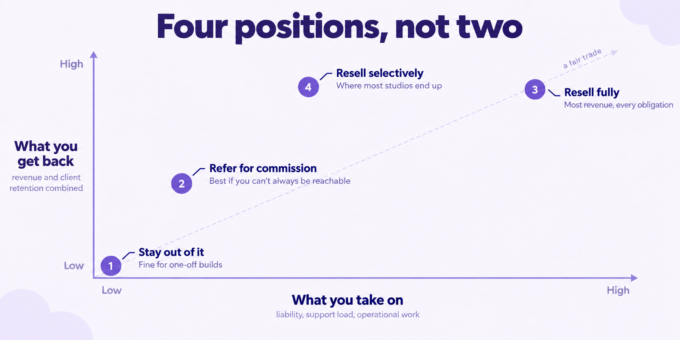
Four ways to handle client hosting (not just two)
Most articles on this topic present a binary: resell, or don’t. There are four positions, and two of them are frequently the right answer.
| Revenue | Liability | Support load | Retention effect | Effort to start | |
|---|---|---|---|---|---|
| 1. Stay out of it | None | None | Low, but unpaid | None | — |
| 2. Refer for commission | Low | Minimal | Low | Weak | Hours |
| 3. Resell fully | Highest | Yours | Moderate to High | Strong | Days |
| 4. Resell selectively | Moderate | Yours, bounded | Moderate | Strong | Days |
1. Stay out of it entirely
The client buys their own hosting. You hold the credentials and use them when you need to.
This is the right answer for a studio doing one-off builds with no ongoing relationship, and it is a perfectly professional position. The cost is that you will still be asked for help occasionally and will still not be paid for it. The benefit is that you own none of the risk in the section above.
2. Refer and take a commission
You recommend a host, the client buys directly, you take an affiliate or referral fee, and support stays with the host.
If you answered no to questions two or three of the qualifying test — you cannot be reliably reachable, or nobody can cover for you — this is the model you should choose. It captures a slice of the revenue and none of the obligation. It is a genuinely good outcome, not a consolation prize, and a lot of studios that “failed at reselling” would have been happy here from the start.
3. Resell under your own name
You buy a reseller account, create accounts for clients, bill them yourself, and are the named provider. Highest revenue, strongest retention effect, and every risk in the previous section is yours.
This is the model the rest of this cluster is written about. It suits studios with a real book of ongoing clients and a tolerance for operational work.
4. Resell selectively
Hosting is offered only to retainer clients, not to everyone.
In practice this is where most successful small studios land, and almost nothing written about reselling acknowledges it exists. You get the recurring revenue and the retention effect from the clients you already speak to monthly, and you keep the one-off, price-sensitive, high-maintenance clients on their own accounts where they cannot generate unpaid work. It also gives your retainer a concrete thing to contain — see hosting inside a retainer vs billed separately.
If you are unsure, start here rather than at model three.
Don’t resell if…
- Your work is mostly one-off brochure builds with no ongoing contact.
- You have fewer than five active sites and no near-term plan for more.
- You already resent the unbilled support requests you get now. Reselling multiplies them.
- You cannot reliably reach a computer within one working day.
- Nobody but you can restore a backup, and you have no intention of changing that.
- You want passive income. This is not that. It is a small service business attached to your existing one.
Any one of these is enough. Model two exists for exactly this reader.
Telling your existing clients
The conversation is easier than designers expect, and it goes wrong in predictable ways.
What works is framing it as consolidation and accountability rather than as a new fee: one invoice, one person to call, no more forgotten renewal notices from a company they don’t remember signing up with. What works for timing is a natural boundary — a renewal date, a redesign, a migration you are doing anyway. What fails is a surprise line item on an invoice.
Something close to this is usually enough:
“I’m taking hosting in-house so that when something goes wrong, it’s me fixing it rather than me emailing someone else’s support desk. It’ll be $25 a month on your existing invoice, and I’ll handle the move — you won’t need to do anything.”
The full version, including how to handle clients who say no, is in telling existing clients you’re taking over their hosting. If you are also correcting years of underpricing at the same time, read raising hosting prices on existing clients first.
A 90-day pilot instead of a decision
You do not have to decide this from an article. You can decide it from your own data in three months.
- Pick three to five tolerant clients. The ones who like you, whose sites are simple, and who would forgive a bad week. Not your largest account.
- Move them at renewal, so nothing is wasted and the timing has an obvious reason. See migrating client sites without downtime.
- Offer one tier only. One price, one set of limits. Tier design is a problem for later; see how to price reseller hosting plans for where to set the number.
- Log every single interaction for 90 days. Date, client, what they asked, how long it took, and whether it was in working hours.
- Then decide, using five numbers: tickets per client per month, the share that were email-related, your longest single incident, hours spent outside working hours, and whether any client questioned the price.
If those numbers look fine at five clients, they will broadly hold at twenty-five. If they look bad, you have learned it for the cost of five accounts rather than fifty.
Frequently asked questions
Do I need billing software like WHMCS to start? No. At ten or fifteen clients, adding hosting to the invoice you already send is fine, and a billing platform licence is a real deduction from a thin margin. Automation earns its place somewhere around thirty accounts, when manual renewals start slipping. If you do want it from day one, some ChemiCloud reseller plans include the WHMCS licence, which takes that cost out of the arithmetic entirely.
What do I charge clients for hosting? Most designers land between $20 and $40 per month, priced as care rather than as storage — clients are buying the fact that you answer. Don’t benchmark against $3 shared hosting; you are not selling the same thing. How to price reseller hosting plans covers the method.
What happens if I want to stop later? You migrate clients to their own accounts, or you sell the book. Neither is difficult if you have kept clean records and have not tied hosting to a contract clause that makes leaving awkward. Plan the exit before you need it.
Am I responsible if a client’s site gets hacked? Practically, you are the one who deals with it. Contractually, it depends entirely on what your terms say about updates, backups and scope. This is the single strongest argument for having written terms before your first client, not after your first incident.
Can I do this with only five clients? You can, but the economics don’t work yet. Five clients is the right size for a pilot, not for a business decision.
Do clients care whose logo is on the control panel? Almost none of them will ever open it. What they notice is the invoice, the sender address on system emails, and who answers when they ask for help. Where white-label seams actually show covers which details are worth the effort.
Reselling hosting is a small operations business bolted onto a design business. For studios with a real book of ongoing clients, it is one of the most reliable pieces of recurring revenue available, and it makes those clients considerably harder to lose. For studios without one, it is a slow drain of unbilled attention.
If the numbers above look workable for your client base, see what our reseller plans include.
If they don’t yet, that is a legitimate answer. Come back when the client list is longer — or run your own figures in the profit calculator and see what number of clients would change your mind.