Live Chat
 Help Center

Reseller hosting means buying server resources in bulk from a hosting provider and selling them on as your own hosting accounts, under your own brand and your own pricing. The provider runs and maintains the servers. You create the accounts, set the prices, bill the customers and answer their support requests.
If you already build or maintain websites for clients, the question in front of you is a different one, and this guide on whether designers should resell hosting to their clients is the better starting point. This page is written for people considering hosting as a business from scratch. If you decide it’s for you, the full walkthrough is in our guide on how to start a reseller hosting business.
How reseller hosting works
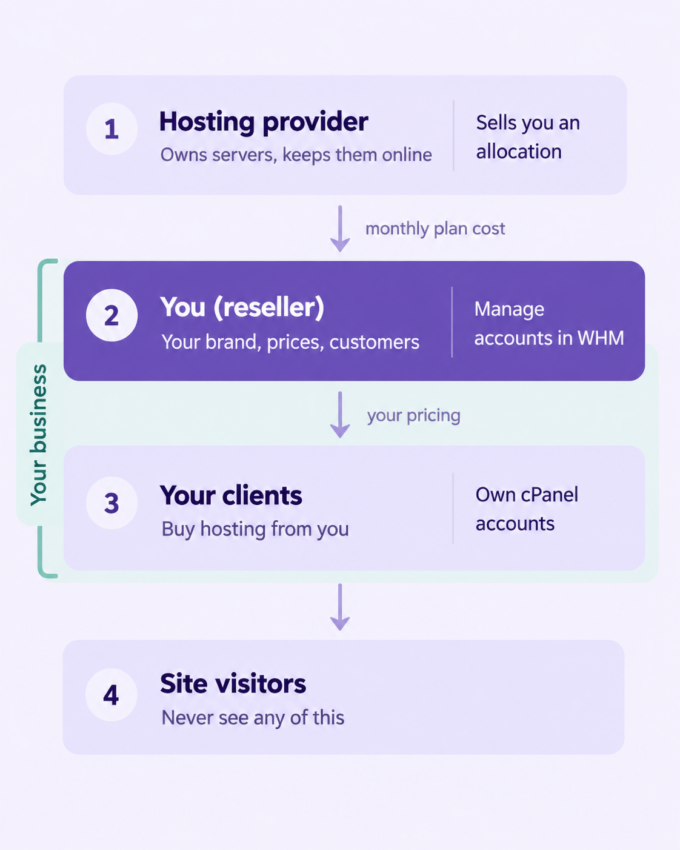
There are four parties in a reseller arrangement, and it helps to be clear about who is who.
At the top is the hosting provider. They own or lease the hardware, keep it patched and online, and sell you a block of resources.
In the middle is you, the reseller.
Below you are your clients, who buy hosting accounts from you.
At the bottom are the people visiting your clients’ websites, who never think about any of this.
What you buy from the provider
A reseller plan is not a bigger shared hosting account. What you get is an allocation of disk space, bandwidth and accounts, plus a control panel that lets you divide that allocation up and hand pieces of it out.
On most providers that control panel is WHM, the administrative layer that sits above cPanel. WHM is where you define hosting packages, create accounts, set resource limits per account, suspend an account that hasn’t paid, and see what’s consuming your allocation. Your clients never see WHM. They see cPanel, in their own account, containing only their own sites. Our guide to WHM for resellers covers what you actually need to know about it, which is less than the interface suggests.
What you sell to your clients
You sell individual hosting accounts on packages you define. A package is a named bundle of limits: so much storage, so many databases, so many email accounts, a bandwidth ceiling. You decide how many packages to offer and what goes in each, and you decide what to charge. The provider has no say in your pricing and no relationship with your customers. See how to create hosting packages in WHM for the mechanics.
This is the part that makes it a business rather than a referral scheme. Your clients are your customers. You own the billing relationship, the support relationship and the renewal.
Who your clients think they’re buying from
By default, some of the plumbing is visible. Nameservers, welcome emails and control panel branding can all carry the upstream provider’s name unless you configure them otherwise.
Setting up private nameservers is what makes the arrangement genuinely white-label: your clients point their domains at ns1.yourcompany.com rather than at your provider. Most reseller plans support this. It takes an afternoon to set up and it is the difference between looking like a hosting company and looking like someone with a hosting account. There are a few other places the seams can still show, which we cover in our guide to white-label hosting.
What you’re responsible for, and what your provider handles
This table is the honest version of the arrangement.
| Task | You | Your provider |
|---|---|---|
| Server uptime, hardware, OS patching | ✓ | |
| Creating and configuring client accounts | ✓ | |
| Setting resource limits per account | ✓ | |
| First-line client support | ✓ | |
| Escalating genuine server problems | ✓ | ✓ |
| Billing, invoicing and chasing late payments | ✓ | |
| Server-level backups | ✓ | |
| Restoring an individual client’s site on request | ✓ | |
| Cleaning up malware on a client’s site | ✓ | |
| Pricing, packaging and renewals | ✓ | |
| Terms of service and acceptable use enforcement | ✓ |
The backup row is the one that catches people out. Your provider almost certainly takes server-level backups, and those exist to recover the server, not to recover your client’s mistake at 11pm on a Sunday. Whether you can pull a single site out of them, how far back they go, and how quickly you can get to them varies by provider and by plan. Read that part of your provider’s terms before you promise anything to a client, and see backups and who’s responsible when a client deletes their site for how to set expectations that you can actually meet.
The wider point the table can’t convey is timing. Support does not arrive when you’re at your desk. It arrives when a client notices something, which is disproportionately evenings, weekends and the week you’re away. That is the single largest difference between hosting and most other side businesses, and it is worth understanding before you take money from anyone.
Reseller hosting vs the alternatives
(Reseller vs shared, VPS and dedicated)
| Reseller | Shared | VPS | Dedicated | |
|---|---|---|---|---|
| What you control | Accounts, packages, pricing | One account | The whole server environment | The whole machine |
| Technical skill needed | Low to moderate | Low | Moderate to high | High |
| Who manages the server | Provider | Provider | You, unless managed | You, unless managed |
| Whose brand your clients see | Yours | N/A | Yours | Yours |
| Typical monthly cost | $20-$50 | $3-$15 | $20-$100+ | $100+ |
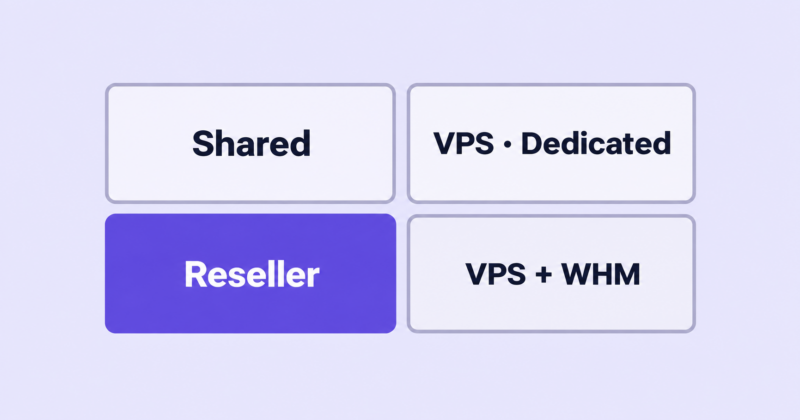
The short version: reseller hosting is the only option on this list designed for selling hosting to other people without also becoming a systems administrator. VPS and dedicated servers give you more control and more responsibility, and most people who need them arrive there after outgrowing a reseller plan rather than starting there. Our full comparison of reseller, shared, VPS and dedicated hosting goes into which is right for which situation.
Reseller vs affiliate programs
These get confused constantly and they are not the same business.
As an affiliate, you send someone to a hosting provider and receive a commission, usually once. The customer belongs to the provider. You don’t set the price, you don’t control the renewal, and you have no relationship to leverage when you want to sell that customer something else.
As a reseller, the customer is yours. You set the price, you keep the recurring revenue, and you carry the support obligation that comes with it. Affiliate income is easier and thinner. Reseller income is harder and compounds.
Reseller vs white-label and managed WordPress reselling
“White label” describes a property, not a product type. Reseller hosting configured properly is white label. Some providers also sell white-label managed WordPress plans, which work similarly but hand you a narrower, more opinionated platform: fewer knobs, better defaults, usually a higher price per site.
Neither is better in the abstract. If your clients are all WordPress sites and you want less surface area to support, a managed platform can be worth the premium. If you want general-purpose hosting you can shape yourself, a reseller plan with WHM gives you more room.
What reseller hosting costs, and what you can charge
The economics are simple to describe and easy to get wrong.
You pay a fixed monthly cost for the reseller plan. You charge each client whatever your packages are priced at. Every account you add costs you nothing extra until you approach your allocation limits, so margin improves with each client until you need a bigger plan.
A rough illustration. Say a reseller plan costs $50 a month and you charge $25 a month for a standard package. Two clients cover the plan. Ten clients produce $250 a month in revenue against the same fixed cost. Twenty clients produce twice that, still against the same fixed cost, assuming the allocation holds.
What that arithmetic leaves out is your time. Support is the real cost of this business, and it doesn’t scale as cleanly as the hosting does. A realistic view of the numbers, including the time, is in how much you can actually make reselling web hosting, and you can run your own figures in the reseller profit calculator. When you’re ready to set actual prices rather than model them, how to price reseller hosting plans covers the method.
Is reseller hosting still a real business in 2026?
It’s a fair question. A lot of the content written about reseller hosting dates from an era when “start your own hosting company” was a stock side-hustle recommendation, and that framing has aged badly. The model itself hasn’t gone anywhere. Where it works and where it doesn’t has just become much clearer.
Where it works
Reseller hosting works when hosting attaches to something you already do or already have.
Designers and agencies with a client base are the clearest case. The clients exist, the sites exist, and the hosting is already being paid for by someone. Moving it in-house adds recurring revenue to a business that otherwise bills project to project.
IT shops and MSPs are the same pattern with different clients. Hosting sits alongside services they already provide and already bill for monthly.
Niche operators are the third case. Hosting for a single industry, sold with the templates, integrations and support knowledge that industry needs, competes on something other than price. That’s a real position. Our guide on why niche hosting beats generic hosting makes the case in full.
Where it doesn’t
It doesn’t work as a way to sell commodity hosting to strangers on price. The bottom of that market is occupied by providers operating at a scale you cannot match, spending on acquisition at a level you cannot match, and pricing accordingly. Starting with no audience, no niche and no existing relationships, and competing on being slightly cheaper, is the version of this business that fails.
The honest summary: reseller hosting is a good business for people who already have a reason for someone to buy from them, and a difficult one for people who don’t.
Why people quit
The common pattern is that the work arrives before the revenue does. The first handful of clients generate support requests immediately and meaningful income slowly, and the ratio doesn’t look encouraging until the account count climbs. People who don’t expect that curve tend to leave somewhere in the first few months.
The other pattern is underpricing. Setting prices against the cheapest shared hosting on the market produces margins that can’t fund the support the clients need, and the business becomes unpleasant before it becomes unprofitable.
What you need before you take on a first client
Not a to-do list for today. A list of what has to exist before someone pays you.
- A reseller plan with WHM access. The account and the allocation. See WHM for resellers.
- A billing platform. Something that invoices, takes payment, handles renewals and suspends non-payers automatically. Doing this manually stops working around client five. WHMCS and Blesta are the usual choices, and licensing is a genuine recurring cost to factor in — some reseller plans, including ChemiCloud’s, include a WHMCS licence, which changes the arithmetic. Compared in WHMCS vs Blesta.
- Private nameservers. So your clients point at your brand. See private nameservers.
- Defined hosting packages. Two or three, priced, with limits set. See creating hosting packages in WHM.
- Terms of service and an acceptable use policy. Not optional. They’re what you point at when a client’s site starts sending spam. See terms of service and AUP for a small host.
- A support process and a response time you can actually honour. Including a plan for the week you’re away.
- A way to find the first client. See finding your first hosting clients.
Common questions
Do I need technical skills? Some, but less than people assume. You need to be comfortable in a control panel, understand DNS well enough to move a domain without downtime, and be able to tell a server problem from a site problem. You don’t need to administer servers. That’s what you’re paying the provider for.
Can I use my own brand? Yes. With private nameservers, custom control panel branding and your own billing system, clients have no particular reason to know who your upstream provider is. Most reseller plans are built for exactly this.
Can I set my own prices? Yes, entirely. Your provider charges you for the plan and has no involvement in what you charge your clients. Pricing is one of the few genuine levers you control, which is why it’s worth thinking about properly.
Is reselling hosting legal? Yes, when you do it on a plan sold for the purpose. Reseller plans exist precisely so that you can sell the resources on. What you can’t do is resell a standard shared hosting account, which usually breaches the provider’s terms.
What happens if a client’s site gets hacked? It becomes your problem first, because your client will contact you. The provider will get involved if the compromise threatens the server. Having a documented process before this happens is worth a great deal. See when a client site gets compromised.
What if I outgrow the plan? You move up to a larger reseller plan, or eventually to a VPS or dedicated server. This is a normal progression rather than a failure, and it’s usually driven by resource limits or by wanting more control. See outgrowing reseller hosting.
Where to go from here
If you already have clients whose sites you build or maintain, start with should web designers resell hosting to their clients. The economics are different when you begin with revenue already attached, and so is the sequence.
If you’re starting from zero, the full walkthrough is how to start a reseller hosting business, and it’s worth reading how much you can actually make before you commit to anything.
Thinking about which plan you’d need? See what’s included in a ChemiCloud reseller hosting plan.