Live Chat
 Help Center

We make reseller hosting, and we’re not the cheapest. This page compares the cheapest cPanel reseller plans from six hosts, including ours. It shows what each one costs after the first year and what the low price leaves out. It also covers when you should buy the cheapest plan anyway, and in one case it’s a competitor’s.
The short answer (verified 5 October 2026): The cheapest entry plans from established cPanel reseller hosts start at $17–$20 a month for the first year, then renew at $22–$41. Plans advertised at $2–$9 a month exist, but they usually carry a small account cap, thin resources per client, or the price applies only to a long prepaid term. The cheapest plan for you is the one with the lowest cost per client over the time you’ll keep it. That’s usually not the lowest sticker price, and occasionally it is.
Starting with no clients and testing the idea? Jump to when the cheapest plan is the right call. The full sequence is in how to start a reseller hosting business. Moving client sites you already host? Start with whether saving $10 a month makes your hosting cheaper, then read the trade-offs.
Table of Contents
- Four different products are sold as “cheap reseller hosting”
- The cheapest cPanel reseller plans, compared
- Why reseller hosting has a price floor
- What the cheapest plans cut
- What a cheap reseller hosting plan really costs over three years
- Does saving $10 a month make your hosting cheaper?
- When the cheapest plan is the right call
- Where ChemiCloud sits on price
- 10 questions to ask before you buy a cheap reseller plan
- FAQ
Four different products are sold as “cheap reseller hosting”
Search for cheap reseller hosting and the lists you’ll find put a $5 plan next to a $20 plan as if they were the same thing. Often they aren’t. Four different products use the name:
| What it’s called | What you actually get | Can you sell cPanel accounts? | Who supports your clients |
|---|---|---|---|
| cPanel/WHM reseller plan | WHM, a separate cPanel account per client, your branding | Yes | You, with the host behind you |
| Agency or multi-site plan on the host’s own panel | Many sites, client access through the host’s dashboard, partial white label | No | You, with the host behind you |
| Storefront “reseller programme” | A branded shop selling the provider’s catalogue; the provider hosts and supports | No — you resell a catalogue | Usually the provider |
| VPS or cloud server with a panel | A server you size and run yourself | Yes, if the licence covers enough accounts | You, entirely |
This page compares only the first kind, which is what most people mean by reseller hosting and what most of your clients will already know how to use. If you’re weighing the last row, reseller vs shared vs VPS covers the trade, and outgrowing reseller hosting covers when to make it.
Not compared here: SiteGround. Its reseller offer runs on its own Site Tools panel rather than cPanel and WHM. If every site you build is WordPress and you’d rather never touch WHM, it’s worth a look, but it’s a different product from everything below. And “free reseller hosting” is almost always a storefront programme or something you shouldn’t put a client on.
The cheapest cPanel reseller plans, compared
Each host’s cheapest cPanel reseller plan, at a 12-month term, from each provider’s own pages. This is a different set of plans from our best reseller hosting comparison, which matches plans by size. Here the question is simply what the cheapest door costs.
| Plan | Intro → renewal ($/mo) | Renewal step | cPanel accounts | Renewal cost per account | Memory / CPU per account | Billing software | Backups | Refund window |
|---|---|---|---|---|---|---|---|---|
| ChemiCloud Kickstart, accounts-optimised ·See our reseller hosting plans | $17.95 → $34.95 | 1.9× | 60 | $0.58 | 3 GB / 2 CPU | Blesta | Daily, 30 kept; you restore a client account from WHM | 45 days |
| ChemiCloud Kickstart, storage-optimised | $17.95 → $34.95 | 1.9× | 40 | $0.87 | 3 GB / 2 CPU | Blesta | Same | 45 days |
| Verpex Reseller 15 | $17.16 → $22.00 | 1.3× | 15 | $1.47 | 2 GB / 2 vCPU | None | Daily, up to twice daily | 30 days |
| InMotion R-1000N | $16.99 → $35.99 | 2.1× | 25 | $1.44 | Not published on the plan page | WHMCS (Starter) | Backup Manager add-on | 90 days on 6-month+ terms |
| GreenGeeks RH-25 | $19.95 → $34.95 | 1.75× | 25 | $1.40 | Not published on the plan page | WHMCS (Starter) | Nightly, kept 24 hours | 30 days |
| hosting.com Reseller 30 | $20.42 → $40.83 | 2.0× | 30 | $1.36 | 2 GB / 1 CPU | None | Daily | 30 days |
| HostPapa Bronze | $17.95 → $34.99 | 1.95× | 20 | $1.75 | 2 GB for the whole plan, divided by you | None on this tier | Daily | 30 days |
Monthly prices in USD on a 12-month term, from each provider’s own pages, verified 1–5 October 2026. Introductory rates apply to the first term only. Renewal cost per account is the renewal price divided by the plan’s account cap: it’s what each client slot costs once the discount ends, if you fill the plan.
Read the second-to-last numeric column before the first. On the sticker price, the six hosts sit within about $3.50 of each other. On renewal cost per account, the spread is threefold. Our accounts-optimised plan is cheapest on that measure because it has the most account slots. That only helps you if you’ll fill them, though, and Verpex’s plan renews at the smallest step on the list.
Why reseller hosting has a price floor
Every cPanel account on a reseller server costs the host money before anyone answers a ticket. A plan priced far below that cost isn’t magic. It’s covering the gap somewhere, and it helps to know where to look.
cPanel licensing. cPanel is licensed per account, and its price has gone up every January since it moved to per-account pricing in 2019. The increase for 2027 has already been announced. We’re a cPanel partner and buy licences at partner rates, so we see that line from the inside: it’s the one cost a host can’t negotiate away. Our cPanel price increase calculator shows what each round does to a host’s bill.
Server capacity. Memory and CPU per account are rationed with limits. Generous limits mean fewer accounts per server, and fewer accounts per server means more servers.
Software licences. LiteSpeed, CloudLinux, malware scanning and similar tools are priced per server or per account, and a host either pays for them or does without.
Backups. Daily copies kept for weeks, stored off the server, that you can restore yourself, cost far more than a nightly copy kept for a day.
People. Someone has to be awake at 3am who can read a PHP error log.
So when a reseller plan is priced well below that stack, the saving usually comes from one of five places: a tight account cap, thin resources per account, a large renewal step, paid add-ons, or a thinner support desk. Sometimes it also comes from packing more accounts onto each server, which is what overselling explains. None of these is a scandal. They’re how cheap plans balance, and the next section shows how to spot each one.
What the cheapest plans cut
Nine things, in roughly the order you’ll notice them missing.
The renewal price
The intro price is a first-year discount, and the renewal price is the one you’ll actually pay. On the plans above, the renewal step runs from 1.3× to 2.1×. Many budget hosts advertise their lowest rate on a three-year prepay, so the headline is both the longest commitment and the smallest number they could print. Compare plans on the 12-month renewal price. Remember that whatever your host charges you at renewal becomes a price rise you either absorb or pass on, and raising hosting prices on existing clients covers that conversation. Ask, too, whether the host holds your price for the term you’ve paid when its own costs rise. We do, including through the 2027 cPanel increase. Not every host says.
Resources per client account
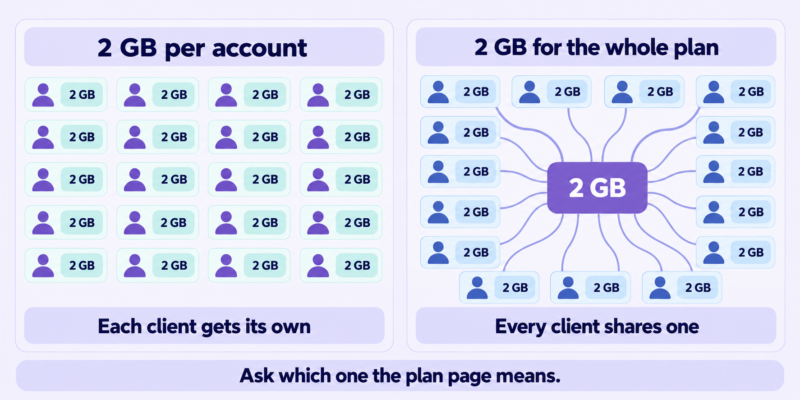
Memory and CPU per cPanel account decide whether a client’s site is quick or slow, and many entry plans don’t publish them. When resellers move their client accounts to us, the reason they give most often is slow-loading sites. That’s a resources problem far more often than a code problem. Look for a per-account figure: ours is 3 GB of memory and 2 CPU cores, Verpex publishes 2 GB and 2 vCPU, hosting.com 2 GB and 1 CPU. Watch for a figure that describes the whole plan: 2 GB shared across 20 accounts is a very different product from 2 GB each. If the plan page doesn’t say, ask before you buy, and treat a vague answer as an answer.
How many accounts you really get
An account cap plus per-account resources is the plan’s real capacity. Fifteen accounts is plenty for a test and tight for a business. “Unlimited accounts” sharing a small resource pool is the same limit wearing a different label. Count the clients you expect in two years, not the ones you have today. Most hosts let you move up a tier without migrating, so a small cap is a cost to plan for rather than a dead end.
Backups you can restore yourself
Three numbers matter: how often, how long they’re kept, and who can restore them. A nightly backup kept for 24 hours means a problem found on Monday morning, from a plugin update on Saturday, has nothing to roll back to. A backup only support can restore means waiting for a ticket while your client waits for you. Check whether you can restore one client’s account from WHM, how many days are kept, and whether backups are included or sold as an add-on. Who’s responsible when a client deletes their site covers the rest.
Support that will touch a client’s site
Your host’s support desk becomes your escalation path, so its scope matters more than its hours. Will it look at a broken WordPress install, or stop at “the server is fine”? Does 24/7 mean a technician at 3am or an acknowledgement email? Is there phone support on the entry tier, or only on the next one up? Poor support is the second reason resellers give us for moving, and it’s the hardest thing to judge from a plan page. A pre-sales chat with a real technical question tells you more than any feature list. What hosting support load actually looks like puts numbers on why it matters.
Billing software
A cheap plan without billing software isn’t cheap if you need billing software. Half the plans in the table include WHMCS or Blesta. For the other half, the cheapest route is a licence bought direct, which the three-year table below adds in. If you bill hosting inside a retainer or through your accounting tool, you may not need it at all — hosting inside a retainer vs billed separately helps you decide. Choosing a billing platform compares the two, and reseller hosting with free WHMCS shows which hosts include which edition.
A white label that holds
Check what your clients will see in someone else’s name. Private nameservers and a branded cPanel are standard on most plans above. The seams are smaller: which notices go to your clients directly, what a suspended page says, what turns up in an email header. White-label hosting: where the seams actually show walks through them, and setting up private nameservers covers day one. For agencies choosing on this alone, best white-label hosting for agencies compares hosts on it.
Security and email reputation
On a crowded server, someone else’s hacked site can become your client’s email problem. Look for three things: account isolation, so one compromised site can’t reach the next; malware scanning that runs on its own rather than on request; and outbound mail filtered through a relay, so a neighbour’s spam run doesn’t land the IP your clients’ invoices leave from on a blocklist. These are rarely on a cheap plan’s feature list because they’re rarely what the cheap plan saved money on — but when they are missing, you hear about it from a client. When a client site gets compromised covers the morning after.
Migrations and the way out
Check what moving in costs, and what moving out will. Most hosts above offer free migrations in some form, but the details vary: some cap the number of accounts, some limit the window. Moving out is the part nobody advertises. If your clients point at your private nameservers rather than the host’s, you can move hosts later without asking twenty clients to change their DNS. Set that up on day one, cheap plan or not. Migrating client sites without downtime covers the mechanics.
Where each cut shows up, and how to check for it:
| What’s cut | Where it shows up | How to spot it on the plan page | Ask before you buy |
|---|---|---|---|
| Renewal price | Year two invoice; your client’s price rise | Intro price only shown on a 36-month term | What’s the 12-month renewal price? Do you hold it for my paid term? |
| Resources per account | Client sites slow at busy times | No per-account memory/CPU, or a plan-wide figure | How much memory and CPU does each cPanel account get? |
| Account cap | Can’t add client 16 | Small number, or “unlimited” with a small pool | What happens at the cap — upgrade without migrating? |
| Backups | A Sunday restoring a site by ticket | “Backups available”, no retention stated | How often, kept how long, can I restore one account from WHM? |
| Support scope | “The server is fine” while the site is down | Phone or chat only on higher tiers | Will you look at a broken WordPress site? |
| Billing software | A second monthly licence | Not listed on the entry tier | Is billing software included on this plan, and which edition? |
| White label | Your client gets an email from your host | Silence on notices and suspended pages | Which notices go to my clients, and in whose name? |
| Security and mail | Client invoices land in spam | No mention of isolation, scanning or outbound filtering | Is each account isolated? How do you handle outbound spam? |
| Migrations | A paid move, or a capped one | “Free migration” with no detail | How many accounts, for how long, and is moving out supported? |
What a cheap reseller hosting plan really costs over three years
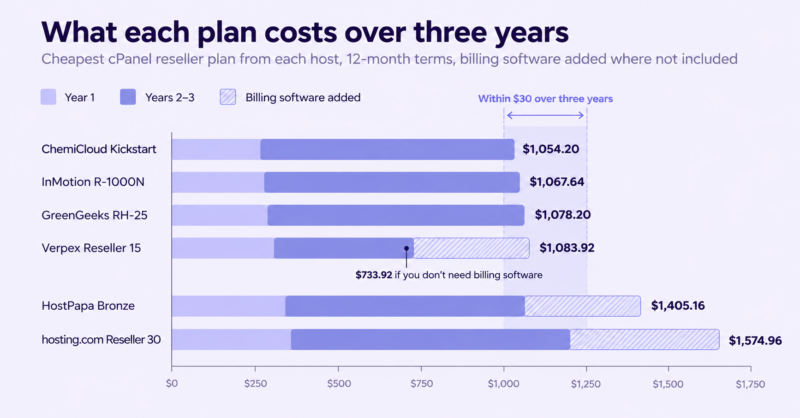
Sticker prices compare one month. You’ll keep a reseller plan for years. Here are the same plans over 36 months, bought on 12-month terms, with billing software added at the cheapest direct price where a plan doesn’t include it.
| Plan | Year 1 | Years 2–3 | Billing software | 36-month total | Per client per month, at 10 clients |
|---|---|---|---|---|---|
| ChemiCloud Kickstart | $215.40 | $838.80 | Included | $1,054.20 | $2.93 |
| InMotion R-1000N | $203.88 | $863.76 | Included | $1,067.64 | $2.97 |
| GreenGeeks RH-25 | $239.40 | $838.80 | Included | $1,078.20 | $3.00 |
| Verpex Reseller 15 | $205.92 | $528.00 | +$350 | $1,083.92 | $3.01 |
| HostPapa Bronze | $215.40 | $839.76 | +$350 | $1,405.16 | $3.90 |
| hosting.com Reseller 30 | $245.04 | $979.92 | +$350 | $1,574.96 | $4.37 |
Billing software for plans that don’t include it is Blesta’s owned branded licence at $350 one-time (blesta.com, checked 5 October 2026), the cheapest direct route. It includes a year of updates; renewing updates is optional and not counted. A monthly licence would add more. InMotion’s total excludes its Backup Manager add-on, which isn’t priced on the plan page. Prices verified 1–5 October 2026.
Two things stand out. If you need billing software, four of these plans land within $30 of each other over three years — about a dollar a month. Price stops being a reason to choose between them, and everything in the section above becomes the reason. If you don’t need billing software, Verpex’s plan is the cheapest by about $320 over the same period ($733.92 without the licence), as long as 15 accounts is enough.
To run it for your own shortlist:
Year 1          = intro price × 12
Years 2–3       = renewal price × 24
Add-ons         = billing software + paid backups + paid migration, if needed
36-month total  = Year 1 + Years 2–3 + Add-ons
Per client      = 36-month total ÷ 36 ÷ number of clients
Does saving $10 a month make your hosting cheaper?
For a designer or agency moving client sites in, the plan price is a cost of goods, and a small one.
Illustrative figures. Say you host ten clients at $25 a month each: $250 a month coming in. A plan that’s $10 a month cheaper saves you $1 per client per month, or $120 a year. Now say one client leaves because their site was slow through a busy season, or down for a day with nobody picking up. You’ve lost $300 a year from that client, two and a half years of the saving, plus the work of replacing them. The hours spent on support tickets a better provider would have prevented sit on top of that.
That’s the arithmetic behind the whole page. On a reseller plan, hosting is rarely your biggest cost. Your time and your clients’ patience are, and those are what the cheapest plans spend. How much you can actually make reselling hosting works through the full numbers, and the reseller profit calculator lets you run your own, with support time shown as an hourly rate. Why hosting clients leave covers how often that second scenario happens. If you’re still setting what to charge, how to price reseller hosting plans starts there.
None of this means the most expensive plan is the right one. It means the comparison that matters is cost per client, plus how many of them you keep.
When the cheapest plan is the right call
Buy the cheapest plan that fits when:
- You’re testing the model. Your own sites and one or two friendly clients, with a plan to move once it’s real. A cheap plan is a sensible way to find out whether you like being the person clients call.
- The sites are low-stakes. Brochure sites with no email, internal tools, parked domains. Thin resources and short backup retention cost little when nothing important lives there.
- You need it for months, not years. If you’ll move or consolidate within a year, the renewal price never arrives.
- You have up to 15 small sites and don’t need billing software. On our numbers, Verpex’s Reseller 15 is the cheapest plan here over three years, with the smallest renewal step and published per-account resources. That’s a competitor, and for that reader it’s the right answer.
If you’re buying cheap, buy it carefully. Pay monthly or yearly, not three years up front, so a bad fit costs you a month and not a prepayment. Check the refund window applies to the term you’re buying. Keep your own off-host copy of anything that matters. Use private nameservers from day one so you can leave without touching client DNS. And our monthly option is $17.95 for the first month, then $34.95. There’s no free or $1 trial, so our 45-day money-back window [VERIFY: applies on the monthly term] is the real test.
You might not need a reseller plan at all. A few sites of your own can live as addon domains on one multi-site shared plan, which is cheaper. The trade-off is that they share one cPanel account: no separate client logins, no isolation between sites, and no clean way to hand one over. Many hosts’ terms also say that hosting other people’s sites needs a reseller plan, so read yours. Moving back from a reseller account into a single shared account is a manual rebuild, not a migration. If you’d rather not be anyone’s host, referring clients to a provider and staying out of the support loop is a legitimate choice too. Reseller vs shared vs VPS covers the options. And if you’ve no clients yet, finding your first hosting clients is the better next read.
Where ChemiCloud sits on price
Not the cheapest entry price. Kickstart is $17.95 a month for the first year and $34.95 at renewal, on a 12-month term. That’s a 1.9× step, above Verpex and GreenGeeks.
Where we’re competitive:
- Cost per account. The accounts-optimised Kickstart gives you 60 cPanel accounts, the most of any entry plan here, at the same price as the storage-optimised version (40 accounts). That’s $0.58 per account at renewal if you fill it.
- Billing software included. Blesta on Kickstart; WHMCS Starter or Blesta from Grow upwards.
- Backups you control. Daily backups, 30 kept, and you can restore a client’s cPanel account yourself from WHM, or ask us to.
- 3 GB of memory and 2 CPU cores per cPanel account, published.
- Free migrations from your clients’ current hosts into the cPanel account you choose. They’re time-limited, and we extend the window on request.
- 24/7 human support, with no AI chatbots, that will look at a client’s site, not just the server.
- Your price held for the term you’ve paid, including through the 2027 cPanel increase.
Watch out for:
- The renewal step: plan your client pricing on $34.95, not $17.95.
- Kickstart includes Blesta, not WHMCS. WHMCS comes from Grow upwards.
- You can’t set CPU or memory limits per client yourself. Raising one account’s resources is a paid add-on.
- No dedicated IPs on reseller plans.
10 questions to ask before you buy a cheap reseller plan
Copy these into a pre-sales chat. If two or more come back vague or unanswered, that’s your answer.
- What is the renewal price on a 12-month term?
- Do you hold my price for the term I’ve paid if your costs rise?
- How much memory and CPU does each cPanel account get?
- What happens when I reach the account cap?
- How often are backups taken, how long are they kept, and can I restore one client’s account myself?
- Will your support look at a broken WordPress site, or only the server?
- Is billing software included on this plan, and which edition?
- Which notices go to my clients, and in whose name?
- Is each account isolated, and how do you handle outbound spam from other customers?
- Is migration in free, how many accounts does it cover, and what’s the refund window on the term I’m buying?
FAQ
What is the cheapest reseller hosting?
Among established cPanel reseller hosts, entry plans start at about $17–$20 a month for the first year and renew at $22–$41 (verified 5 October 2026). Plans advertised below $10 exist, but they usually trade on account caps, per-account resources or long prepaid terms. Compare cost per client over the time you’ll keep the plan, not the first month.
Is $5 reseller hosting legit?
Sometimes. First check which product it is: a real cPanel/WHM reseller plan, an agency plan on the host’s own panel, or a storefront programme. If it’s cPanel reseller hosting, ask for the renewal price, the per-account memory and CPU, the account cap and the backup retention. A legitimate budget host will answer all four.
Why does reseller hosting renew at a higher price?
The first-term price is a discount to win you. The renewal price is the host’s actual price, which has to cover per-account cPanel licensing, servers, backups and support. On the plans compared here, renewal runs 1.3× to 2.1× the intro rate.
Is unlimited reseller hosting really unlimited?
No. Every plan is limited by something: account count, disk space, or a shared pool of memory and CPU. “Unlimited” usually means one limit has been moved somewhere less visible. Ask what the resources are per account.
Can I start with a cheap plan and upgrade later?
Yes. Most hosts let you move up a tier without migrating. If you’d rather change hosts, private nameservers set up on day one mean your clients’ DNS doesn’t have to change. Migrating client sites without downtime covers the move.
Is cheap reseller hosting worth it for a web designer?
For testing the model, yes. For a business with client sites you’re responsible for, compare cost per client rather than monthly price. A plan that’s $10 a month cheaper saves $1 per client per month at ten clients, and losing one client because a site was slow or down costs far more.
If you’re moving 10–60 client sites and want billing software, backups you restore yourself and human support included, compare what a ChemiCloud’s reseller hosting plan costs per client, not per month.
Before you pick any plan on price, run your own numbers in the reseller profit calculator. And if you’re leaving a cheap plan that didn’t work out, migration from your current host is free — here’s how the move works.